
Solemnity of Pentecost, Translation of St. Dominic
Rome, 24 May 2026
Prot. 50/26/175 Letters to the Order
As Fishers and Shepherds: The Dominican Journey with the Church toward Pentecost 2033
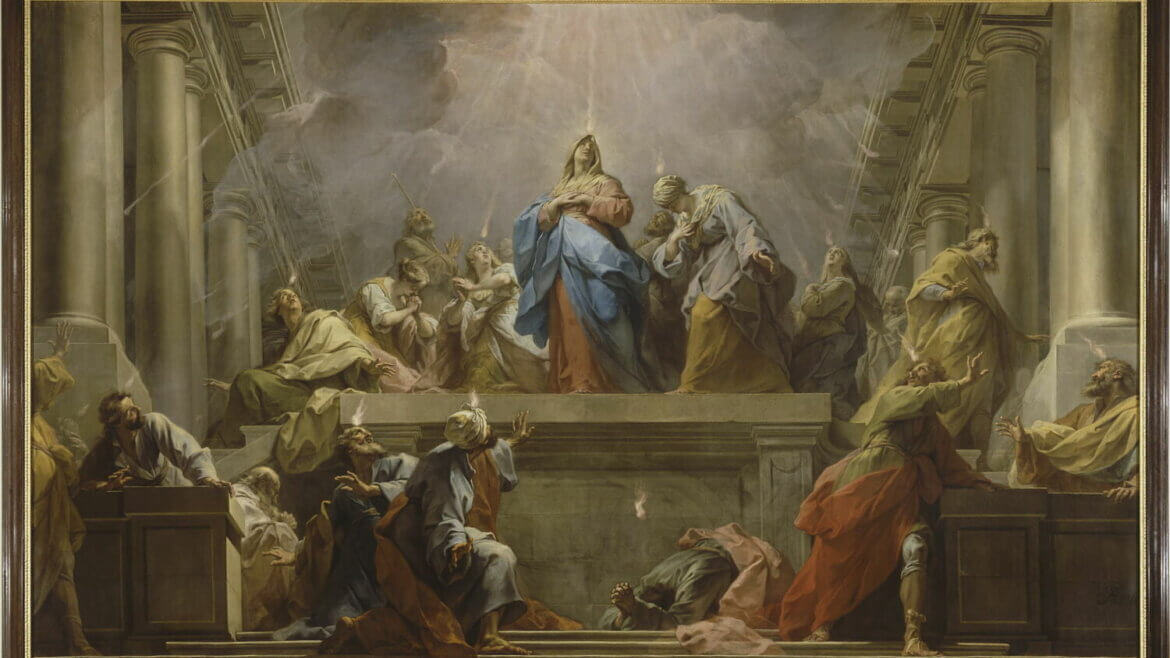
Pentecost marks the inaugural preaching of the apostles: when the Holy Spirit descended upon them, their faltering fear turned into faith-emboldened proclamation, announcing the Gospel in many languages to the ends of the earth. As Leo the Great vividly puts it, “from this day of Pentecost, the trumpet of evangelical preaching thundered forth.” John Chrysostom captures the same transformation at the personal level: the Peter who had once been too frightened to speak boldly even before a single servant girl (Matt 26:69-70) now stood before an entire unsympathetic crowd, proclaiming the Resurrection with courage and eloquence (Acts 2). St. Dominic understood the Order as a continuation of that same apostolic life and mission. Significantly, he convoked and celebrated the first General Chapters in 1220 and 1221 on the solemnity of Pentecost. By gathering on this feast, the friars entrusted their deliberations to the guidance of the Holy Spirit, sought communion in discernment, and affirmed that governance in the Order is a spiritual act, not merely an administrative one. Dominic’s choice was intentional: it rooted the Order’s identity in an apostolic, outward-looking, and Spirit-led vision. In this light, General Chapters are not simply assemblies, but privileged moments of communal discernment, governance, and renewal; indeed “pentecosts” in their own way, renewed again and again in the life of the Order. My successor will have the privilege of leading the Order when the Church marks the great jubilee of the Redemption and Pentecost in 2033. Yet I wish to invite you, even now, to reflect on how we might prepare for that day, and to consider what we are called to offer the Church as we journey together toward that momentous event of grace.
Fellow Workers for the Truth (3 John 8)
The following reflection is offered to the whole Dominican family: friars (clerical and cooperator), contemplative nuns, apostolic sisters, members of the priestly fraternities, secular institutes, Dominican laity, and Dominican youth movements. While the particular form of Dominican life differs according to each member’s state of life, this reflection speaks to what is held in common: the shared inheritance of St. Dominic’s vision and the shared propositum Ordinis (cf. LCO 141). More profoundly, we all “share in Christ’s priestly, prophetic, and kingly offices by incorporation into Him through Baptism.” No member of the Dominican family stands outside this dignity, and each participates, in his or her own proper way, in the mission of Christ to bring truth, sanctification, and life to the world. It is this shared baptismal dignity that makes us, in the words of the Third Letter of John, “fellow workers for the truth” (3 John 8), a phrase that captures the Dominican identity in all its forms, since the pursuit and proclamation of truth, Veritas, is the very heart of the Order’s charism. United by this common vocation, each branch of the family serves the mission of the Order in its own distinctive way (cf. LCO 141). The saints of the Order bear the most eloquent testimony to the many forms Dominican preaching can take: Dominic’s itinerant proclamation, the teaching of Thomas Aquinas and Albert the Great, the writings of Catherine of Siena, the art of Fra Angelico, the charity of Martin de Porres and Rose of Lima, the youthful witness of Pier Giorgio Frassati, the blood of the martyrs. In Praedicator Gratiae, Pope Francis celebrated precisely this apostolic variety as a gift the Order continues to offer the Church.
The Four Publics / Interlocutors of Our Preaching Today
You will recall that, in my letter of 24 May 2025, I invited you to give renewed and particular attention to those to whom our preaching is directed, the four publics. It is our earnest hope that these “publics,” responding to the Word proclaimed, may become true “interlocutors”: our companions in the ongoing dialogue with God and about God. In the same spirit, I asked the General Chapter (Kraków 2025) to examine and propose concrete ways in which the propositum Ordinis may be brought more effectively to bear upon our mission to these publics. Pope Leo XIV, in his letter to the capitulars, encouraged us all: “Your chosen theme — to address in a more dedicated way your varied forms of preaching to ‘four publics’: those who do not yet know Jesus, the Christian faithful, those who have fallen away from the Church, and the young people found in these situations — is particularly timely.” As we prepare for the Jubilee of the Redemption and Pentecost 2033, I renew my invitation for the Order to place the propositum Ordinis concretely at the service of the Church’s mission of a new, or renewed, evangelization, by focusing on the following four missions:
1. Mission ad gentes: the “mission” to those who have not yet known Jesus.
“I even discovered an altar inscribed, ‘To an Unknown God.’ What therefore you unknowingly worship, I proclaim to you” (Acts 17:23). Today, the place of mission is no longer only somewhere far from home, it is also right on our doorstep! Upon leaving our convents or houses, we encounter not a few men, women, and children who have not yet come to know the joy of friendship with Jesus Christ. Hence, missio ad gentes is not confined to certain regions, but extends to all contexts wherein Christ remains unknown. We gratefully recognize our brothers and sisters who labor in territories where the Church is still taking root. At the same time, numerous members of the Dominican Family are already engaged in reaching out to “seekers”, those who have not yet heard or believed in Christ, through their work in universities, the so-called digital continent, and other contemporary areopagi of preaching.
2. Mission to deepen the faith of believers: the “mission to Theophilus”
“I have decided to write an ordered account for you, Theophilus, so that you may learn how well founded the teaching is that you have received” (Luke 1:1–4). Luke addressed his Gospel to Theophilus, a “friend of God”, who stands as a type of every believer who desires to know God more deeply. Caring for a stable community of faith, walking with its members through their journey of life and faith, is itself a form of itinerancy. This is the daily work of our brothers and sisters in parishes, schools, universities, chaplaincies, retreat centers, and the like. Nevertheless, this mission must ever remain intrinsically open to missio ad gentes: parishes are to extend themselves toward those who are unaffiliated and toward seekers; institutions of learning are to remain attentive and hospitable to those who do not yet believe. The deepening of faith and its missionary dynamism are not to be separated, for both are inseparable aspects of the one apostolic mandate.
3. Mission to those who are drifting away from the Church
These are the disciples on the road to Emmaus, walking away from Jerusalem, away from the community of faith. Their “eyes were prevented from recognizing Jesus,” who walked beside them; yet later, they recognized Him in the Scriptures and in the Breaking of Bread (Luke 24:13–32). Secularization has led many people to drift gradually from the practice of the faith. They have lost the capacity to recognize Jesus in Word and Sacrament. How do we engage them and invite them to see Him once again? There are also, sadly, those who have walked away because they were scandalized, wounded by the sexual, spiritual, or psychological abuses committed by members of the Church. How do we walk with them, speak with them, and sit at table with them, as Dominic did with the “innkeeper” (cum hospite domus)? What are we doing as an Order to invite these people back into the community of faith? What more can our preaching, verbis et exemplis, do to help them recognize Jesus in His saving Word and in the Breaking of Bread? How might the wounds through which the Apostle Thomas came to confess, “my Lord and my God,” become, by grace, a source of healing for those who suffer the wounds of broken trust and fractured relationships?
4. A special mission to young people
Young people are present in each of the faith situations described above. Many, even in places steeped in Christian culture, are not leaving the Church, they have never entered it, because their parents chose not to bring them up in the faith. “Teacher, what good must I do to gain eternal life?” (Matt 19:16). Many young people today carry a question much like that of the rich young man. We must welcome them and engage them in their search for what is true and good. Our brothers and sisters working in schools, universities, chaplaincies, parishes, and shrines minister to young people and share a mission not unlike that of the apostle Andrew. It was Andrew who recognized, in the story of the feeding of the multitude, that a young boy had something to offer (John 6: 5-15). Without the boy, there would have been no miracle; without Andrew, the boy’s offering might never have reached Jesus. We need Andrews today, men and women who can recognize and accompany young people willing to offer their gifts and talents to the Church.
Addressing the Publics: Biblical Figures of Fishers and Shepherds
The New Testament offers two compelling images for those entrusted with the mission of evangelization: the fisher and the shepherd. At first glance, they seem to belong to different worlds: one scanning the horizon of the Sea of Galilee, the other navigating the familiar terrain of hills and pastures. Yet read and contemplated together, they reveal the full arc of the apostolic mission: to “go into all the world and preach the Gospel to every creature” (Mark 16:15).
The image of the fisher speaks of initiative and outreach. When Jesus calls Simon and Andrew with the words “Follow me, and I will make you fishers of men” (Matt 4:19), He is describing a mission that goes out, that casts its net wide, that ventures into deep and unfamiliar waters. Fishing is an act of seeking. It requires patience, courage, and a willingness to work in the deep waters, often without immediate results. For a renewed evangelization, this image reminds us that the first movement is always outward: toward those who do not yet know Christ, toward the margins, toward the open sea of a secularized and searching world. But the catch must be tended. This is where the image of the shepherd becomes indispensable. When the Risen Christ asks Peter three times “Do you love me?” and three times commands him “Feed, tend my sheep” (John 21:15–17), He is entrusting him not only with proclamation but with care, with the slow, patient work of formation, accompaniment, and healing. The shepherd knows his flock by name. He goes after the one who is lost. He does not abandon the wounded. Taken together, these two images do not describe separate missions, but two inseparable dimensions of the one apostolic vocation. The Church is sent both to go out and to gather, to proclaim and to care, to seek those who are far off and to nourish those who have been found. The fisherman without the shepherd risks bringing in a catch that is never sustained; the shepherd without the fisherman risks tending a flock that no longer grows. In their unity, however, they reveal the fullness of the evangelical task. For us, especially as preachers in the spirit of Saint Dominic, this means that our mission must always hold together the boldness of proclamation and the fidelity of accompaniment: to draw people to Christ through the Word, and to lead them, patiently and faithfully, toward maturity in Him. “Fishers of Humans” (ἁλιεῖς ἀνθρώπων) — Mark 1:17//Matthew 4: Fishing is an art of patient, skillful, and often uncertain initiative. Fishers depend on knowledge of the waters, on the right moment, on the cooperation of wind and tide. They can cast their net well and return empty-handed, as the disciples discovered after their long night on the Sea of Tiberias (John 21:3). Yet when Christ says, “I will make you fishers of men”, He speaks as one who already knows every fish in the sea, one who casts the net of His Word across all peoples, all times, and all places. As fishers of humans, we participate, however partially and imperfectly, in a divine reaching-out that knows no horizon. This has profound implications for our understanding of the first and third publics: those who have not yet heard the Gospel, and those who are drifting away from the faith. Preachers who venture into unfamiliar waters, who cast the net where nothing stirs, who labor without visible results, they do not work alone. They participate in the inexhaustible, sovereign initiative of God Himself: “But now I will send for many fishermen, declares the Lord, and they will catch them” (Jer 16:16). The missio ad gentes and the mission to seek out those who are drifting away are participations in a divine mission that neither tires nor fails. “The kingdom of heaven is like a net that was cast into the sea, and gathers from every kind” (Matt 13:47). The patristic tradition reads this parable with remarkable clarity. The sea signifies this present age; the net, entrusted to fishermen, draws all people up from its turbulent waters toward the eternal kingdom. For instance, Augustine reads the 153 fish hauled up by Peter and his companions as the symbolic totality of the redeemed, the fullness of all nations gathered into the net of the Gospel. No creaturely net could hold such a catch; only the net of the divine Word, cast across all history and all peoples, can. The vocation of the fisher of humans is therefore radically outward-facing and radically urgent: the sea is vast, the net must be cast wide, and no one is to be excluded from its reach in advance. And yet a real and spreading inertia afflicts parts of the Church today. As one sharp observer has noted, too many Christians have become no longer fishers of men but keepers of the aquarium! Here, then, are some things we need to relearn, or perhaps hear anew, about what it truly means to be sent as fishers of men:
1. Fishers know how to collaborate
Fishers know how to collaborate. This is not merely a practical observation; it is written into the nature of the craft itself. Large nets require many hands. A boat must be crewed. The catch, when it comes, must be hauled in together, or it is lost. From the beginning, fishing has been a collaborative work, so has the apostolic mission that Christ built upon it. Peter was not alone when the Lord said to him: “Put out into deep water and lower your nets for a catch” (Luke 5:4–11). The command was addressed to Peter and his companions. The nets were plural. There were many hands. And when the catch came, so vast that the nets began to tear, it was only because his companions in the other boat came quickly to help that anything was brought safely to shore. Without that collaboration, the abundance itself would have been lost. The miracle did not eliminate the need for others; it intensified it. Grace does not make community optional, if anything, it makes it more necessary: the more generously God gives, the less any single pair of hands can hold. This is why the apostolic life, as St. Dominic understood it, is inherently communitarian, not as a concession to human weakness, but as a participation in the very life of the Blessed Trinity, a communion of Persons. We are not sent out alone, we are sent as a community, a school of preachers whose life together is itself part of the preaching – forma vitae jam est in actu praedicatio (ACG 1974, 253 II, 3). The world does not only hear what we say; it watches how we live with one another. And when it sees genuine charity, genuine solidarity, genuine mutual support in our work, it catches a glimpse of the communion for which it longs. One does not cast nets in the deep alone. He who tries will not fish well, and will not fish for long. Isolation may feel, at times, like freedom, or even like efficiency. But the solitary apostle, cut off from the common life, from shared prayer, from fraternal correction and encouragement, is a fisherman who has wandered far from the boat. And when the nets grow heavy and the night grows long, there will be no one in the other boat to come to his aid. That is why fishers know they must collaborate.
2. Fishers go into deep waters for a better catch
A fisherman who remains in the harbor, however peaceful and well-ordered, is not fishing. He may be doing many good and necessary things: mending his nets, caring for his tools, helping others, resting. All of these have their place. But the fish are not in the harbor. And if they are elsewhere, then sooner or later he must find the courage to set out again. So it is with us. We are deeply grateful for the places that sustain our life and vocation. Our convents, our parishes, our shrines, our classrooms, these are not obstacles to mission; they are gifts. They are places where faith is nourished, where truth is handed on, where community is formed, and where we ourselves are strengthened for the work we are called to do. But they are not where the nets are cast. The call of the Gospel always carries us further out, beyond what is familiar and secure. The Lord summons us: “Go out into the whole world and proclaim the Good News” (Mark 16:15). Part of that world now unfolds in places we cannot see or touch in the usual way. The digital spaces where so many people live, search, and speak have become, in their own right, a new kind of continent, with its own landscapes, its own communities, its own hunger. There, too, people are asking the deep questions, carrying hidden burdens, seeking connection that goes beyond what the surface of those spaces usually offers. If we are absent from them, many will go unaccompanied, not because no one cared, but because no one came. To be present there does not require us to become something other than ourselves. It asks only that we bring the same spirit we have always been called to live: a willingness to meet people where they are, to listen with patience, to speak with clarity and kindness, and to remain long enough to be known. Beneath all of this lies something deeper still, something that touches the very rhythm of the apostolic life. There is a quiet order in the way the Lord forms His disciples. Before Simon Peter is charged to feed my sheep (John 21:17), he is first sent to cast the net (John 21:6). The going out comes before the tending. The gathering comes before the shepherding. This is not accidental. The Church always holds these two movements together: going out in search of those not yet gathered, and caring for those who have been. Both are essential. But when the first is neglected, the second begins, slowly and quietly, to diminish. A flock, however lovingly tended, cannot remain the same forever if new life is never welcomed in. The call to go out is not an added burden, it is intrinsic to our apostolic life. This was true for the apostles. It was true for St. Dominic, who did not wait for the world to find its way to him but went out to meet it where it was, on the roads, in the heart of the questions of his time. The call is to step out again with trust and simplicity, confident that the Lord who summons us also goes before us, already present in the deep waters to which He sends us.
3. Fishers know not to frighten the fish away
Those who fish learn, over time, that not every fish is reached in the same way. The wise fisherman does not rely on a single method for every water or every season. He pays attention. He learns. He adapts, not because he lacks conviction, but because he is serious about what he seeks. And so it is in the work entrusted to us. Some are drawn slowly, through patience and quiet accompaniment. Some need first to be welcomed and nourished before they are ready to follow. Others are reached only when the net is cast wide, embracing them before they even know they are being sought. The Gospel itself does not change, it remains ever the same, ever true, but the way we offer it, the manner in which we approach others, and the care with which we speak must all be shaped by love and attentiveness. This calls us, gently but honestly, to look at ourselves. Not to harsh self-judgment, but to a humble openness before God. We might ask simply: in the way we live and speak, do we help others draw nearer, or do we sometimes, without intending to, make that step more difficult? We know that not everyone will receive the Gospel. The word of Christ has always been, for some, a stumbling block, and we are not called to soften its truth in order to make it more palatable. But we can still ask whether our manner of speaking reflects the patience and mercy of the One we proclaim. It is not always the message that creates distance. Sometimes it is the tone, one that feels more like judgment than invitation. Sometimes it is a lack of visible joy, or a gap between what we preach and how we live, which the world, whatever else it may have lost, still has eyes sharp enough to notice. And sometimes what is most needed at the beginning is not correction but welcome; not the full weight of doctrine, but a language simple and warm enough for those who are still finding their way. The net must be cast. The world is wide, and many are searching, more, perhaps, than we realize, and in places we have not yet thought to look. But the net must be cast with care: with attentiveness to the moment, to the person, and to the quiet promptings of grace. Gregory the Great knew this well. Mindful of the preacher’s need to read his listeners, he wrote: “One and the same exhortation does not suit all, inasmuch as neither are all bound together by similarity of character. For the things that profit some often hurt others; just as herbs that nourish some animals are fatal to others, and the medicine that abates one disease aggravates another. The discourse of teachers ought therefore to be fashioned according to the quality of their hearers, so as to suit all and each for their several needs, and yet never deviate from the art of common edification.” After His resurrection, the Lord did not tell His disciples to fish harder. He invited them to trust Him differently, to cast the net on the other side (cf. John 21:6). It was a small gesture, almost an ordinary one. But when they obeyed, they found what all their previous effort had failed to produce. This, perhaps, is the invitation extended to us as well. Not to abandon the mission, but to renew our trust in the One who directs it. Not merely to do more, but to listen more deeply. For what bears fruit is not always greater effort in the same direction, but the quiet humility to follow where the Lord leads, even when He leads us to cast the net differently than before.
4. Fishers haul all kinds, without distinction
The dragnet of the kingdom gathers every sort. It is an act of mercy, not of laxity, but of genuine mercy, to cast the net even for sinners, for the doubting, for the hostile, for those who think themselves beyond reach, and to bring them to Christ without prejudging what grace may yet do in them. We are not the judges of who is catchable. The sorting is not ours to perform; it belongs to the end of the age (Matt 13:47–49). Our task is simply to cast, and to cast wide. The very breadth of the net is a sign of divine generosity, for “God wills everyone to be saved and to come to knowledge of the truth” (1 Timothy 2:4). So too in preaching: we offer the Word universally, leaving the response to grace and the judgment to God. Thomas Aquinas reminds us that “God wills all men to be saved by his antecedent will”, a divine desire, prior to all circumstances, that every person should reach the shore safely. Reflecting on the parable of the wheat and the weeds, with insight that applies equally to the parable of the dragnet, Augustine writes: “The reapers will come, but the reapers are angels, not human beings, and human beings who grow indignant against the wicked are simply proving that they are still human, still capable of error, still liable to uproot wheat while meaning to uproot weeds.” The harvesting and the sorting are not yet done. This means, crucially, that the bad are not yet fixed in their badness “let the bad be changed and let them imitate the good” (mali mutentur, et imitentur bonos), a hope Augustine states not as a pious wish but as a real possibility, held open by the very delay that may frustrate us. Fishermen know that bad fish will not turn into good fish, so they throw them away. Fishers of men know otherwise: bad persons can become good. The persecutor Saul became the apostle Paul, and that transformation stands as proof that no one is beyond the reach of grace before the final sorting comes.
5. Fishers know the virtue of patience
A fisherman cannot force the fish to bite or enter the net; neither can we force grace into a human heart. Peter, John, and their companions caught nothing all night long. But when they listened to the voice of Jesus and acted on His word, they hauled a catch beyond their capacity to contain. To be fishers of humans, we must be people of deep prayer and contemplation, attentive to the voice of Jesus, ready to throw the net to the other side when He commands it (Luke 5:4–11; John 21:6), and patient enough to trust that God’s grace is already at work in ways we can neither see nor measure. The night that ends in apparent failure is not wasted in God’s hands; in His loving providence, even the waiting that feels empty is forming us for what is yet to come.
6. Fishers mend their nets
Fishers know that there is a time to cast the net and a time to mend it. The Gospel tells us that James and John were mending their nets when Jesus called them (Matt 4:21). Even in that quiet, hidden work, the Lord was already drawing them into His mission. And so it is with us, sons and daughters of Dominic. To mend our nets is not simply to repair what is torn. It is to attend, patiently and honestly, to all that has frayed in us: to strengthen what has weakened, to gather what has come loose, to renew what has grown tired. For the Lord does not send us out carelessly. When He calls us to cast again into the deep — duc in altum — He desires that the nets we carry be worthy of the abundance of His grace. But the sea before us is no gentle pool. The sea of this age is restless: secularized yet searching, divided and wounded, yet aching for concord and communion. It is deep water. And to cast our nets into it requires more than training or experience. It requires courage. The courage to leave the safety of the shore. The courage to release what we hold in our hands. The courage to trust that the word spoken to Simon Peter is still spoken to us: “Put out into the deep” (Luke 5:4). The words of the Lord are not merely a memory; they are a summons. And so we must ask ourselves, with sincerity and without evasion: where are our nets? Are they stretched out upon the waters, offered in trust? Or are they still folded, carefully kept, resting on the shore? And if they remain on the shore, what has held them back? Weariness? Fear? Discouragement? A slow, quiet loss of hope? The Lord still calls. The deep still awaits. And the net, however worn, can still be mended. What remains is simply this: that we rise, take it in our hands once more, and trust Him enough to cast again. Our brother Thomas Aquinas, drawing on Remigius of Auxerre, captures beautifully what it means to be fishers of men: “By the net of holy preaching they drew fish, that is, men, from the depths of the sea, that is, of infidelity, to the light of faith. Wonderful indeed is this fishing! For fishes, when they are caught, soon after die; but when men are caught by the word of preaching, they are rather made alive.” “Shepherds of the Flock” (ποιµαίνειν τὸ ποίµνιον) — John 21:16–17 and 1 Peter 5: There is something quietly luminous in the sequence John’s Gospel presents. The same hands that hauled the net ashore at the Lord’s command are, within moments, entrusted with the care of his sheep (John 21). Jesus does not separate the two images, he weaves them together in the one apostle, as if to say that the one who goes out to seek and the one who stays to tend are, in the end, moved by the same love. The fisher and the shepherd are not two vocations but one: a single heart, turned wholly toward the lost and the found, the far and the near, the deep waters and the quiet pasture. It is with this vision before us that we turn now to contemplate the second of our two images, the shepherd, and what it asks of us in our mission to those already gathered, already found, already beloved. When the Risen Christ says to Simon Peter, “Feed my sheep” (John 21:17), He speaks as the Good Shepherd, the one who knows His sheep by name, who lays down His life for them, who leaves the ninety-nine to seek the one that is lost (John 10:3; Luke 15:4). As shepherds of His flock, we participate, however partially and imperfectly, in a divine caring that neither sleeps nor tires. The flock is not ours; it is His. We tend to what belongs to God, in His name. This has profound implications for our understanding of the second public: those who have already heard the Gospel and received the faith, but who must now be nourished, protected, and accompanied toward deeper faith and commitment, so that they, too, may participate in shepherding. Preachers who remain with the flock, who know their people by name, who accompany them through doubt, difficulty, and loss are participating in the inexhaustible, tender initiative of God Himself: “I will gather the remnant of my flock from all the lands to which I have banished them and bring them back to their folds” (Jer. 23:3). We rejoice at the growth of adult baptisms in many parts of the world, for every conversion is a sign of the Spirit’s fruitfulness and a renewal of the Church’s apostolic hope. Yet baptism is not an arrival but a threshold; and the shepherd’s responsibility does not end at the font, for the newly baptized must be led, in the ancient tradition of mystagogy, ever more deeply into the mystery they have entered and the faith they have professed. Without this patient, ongoing accompaniment in doctrine, prayer, and the life of grace, the seed sown in the waters of baptism risks falling on shallow ground, and what was received as a gift might, for want of formation, quietly wither before it bears fruit (cf. Matt 13:5–6). The Good Shepherd “leaves the ninety-nine to seek the one sheep who is lost”. But in our time, it seems that the reverse is happening in some parts of the world; only few remain in the sheepfold and the “ninety-nine” have left our churches! This has implications for the third public. The flock has not been driven away by persecution or sudden catastrophe; it has drifted, quietly and gradually, through a slow failure of accompaniment, a poverty of genuine pastoral presence, a gap between what the Church proclaims and what those within her have actually experienced. The sheep were not stolen; in many cases, they simply drifted away. Perhaps some knocked at our door and found it unwelcoming; or some had genuine questions and were met with dismissal rather than engagement. We need to give the people the shepherd’s care (1 Peter 5:2-4) that they deserve so that they may be strengthened in their faith. Here, then, are a few things we need to keep in mind about the art of shepherding, that we may fulfill our mission of preaching for the salvation of souls:
1. Domini Canes: shepherd dogs of the Good Shepherd
The supposedly medieval wordplay on the name Dominican, Domini canes, the hounds of the Lord, is more than a clever pun. It is a theological image that deserves to be taken seriously, especially in the context of any pastoral or parish ministry. In the ancient and medieval imagination, the dog was above all a watchdog and a sheepdog: vigilant, loyal, tireless, and wholly oriented toward the master whose flock it served. It did not own the sheep, nor did it lead them in its own name. Its purpose was singular: to keep the flock close to the shepherd, to warn of approaching danger, and to pursue and recover what was straying, all by the one instrument proper to it, its voice (“bark”). One of the earliest identifications of dogs with Dominicans comes from Albert the Great. Reflecting on the parable of the rich man and Lazarus, he cites the verse “even the dogs came and licked his sores” (Luke 16:21) and writes that this has been fulfilled in his own time: “the hunting dogs are the preaching Orders (Ordines praedicantium): they do not remain at home but go out to the poor, tending the wounds of their sins, bearing in their mouths the bark of preaching (latratum praedicationis).” Albert is sharply critical of clerics who have failed in their duty to preach, likening them to what Isaiah calls “blind sentinels, mute dogs, unable to bark” (Isa 56:10–11). Against this failure he sets the figure of the good preacher. The good dogs, he writes, carry “in their teeth the bite of rebuke and correction: ‘Reprove, entreat, rebuke with all patience and doctrine’ (2 Tim 4:2); and on their tongue the medicine of healing: ‘The tongue of the wise is health’ (Prov 12:18).” The good preacher, then, is the living dog: endowed with the grace of preaching in his bark, the power of correction in his bite, and the gift of healing in the counsel of his tongue. Crucially, sheepdogs do not work alone. Anyone who has watched them at work across a hillside knows that their effectiveness lies in coordination: one ranging wide to gather strays, another holding the flank, another pressing the flock forward, all attentive to the same master’s call and ordered toward the same end. No single dog sees the whole terrain; none can be everywhere at once. It is precisely their working together under the shepherd’s direction that makes the difference between a gathered flock and a scattered one. Here the image illuminates Dominican pastoral ministry at its best: not a single brother bearing the entire burden in isolation, but a fraternity ranging across the same pastoral field, each offering his particular gifts, each responsive to the same Lord, and together accomplishing what no one could achieve alone. The image extends naturally to the Dominican vocation as a whole. We do not shepherd in our own name. Christ alone is the Good Shepherd (John 10:11), we are merely His hounds: sent, trained, and placed in His service, wholly ordered toward Him and toward the care of those who belong to Him. The proper instrument of this service is the word, the “bark,” (if one accepts the image on its own terms) that warns, recalls, and gathers. Preaching, for a Dominican, is not self-expression but witness: the cry of one who has perceived danger and refuses the complicity of silence. At the same time, the image carries a necessary humility. The sheepdog is not the shepherd. It possesses no authority of its own, no independent flock, no private mission. Its fruitfulness depends entirely on its attentiveness to the master, on how well it knows his voice and how faithfully it follows his direction. Here again the communal dimension is decisive: a sheepdog that begins to act on its own, ignoring the shepherd’s call, does not merely falter, it disrupts the work of the others, scattering what they are striving to gather. So too the Dominican who pursues his own pastoral vision apart from the fraternity, however gifted, risks introducing division rather than care. Communal discernment is not a limitation on apostolic effectiveness; it is one of its essential conditions. Gregory the Great warns that when a pastor falls silent out of fear of displeasing, he allows a “plague of silence” to grow within. The watchdog that does not bark when the wolf approaches has failed in the very purpose for which it was set there. Its silence is not prudence but neglect. For a Dominican preacher, the prophetic dimension of preaching, its readiness to challenge, to correct, and to name what draws the flock away from Christ, is not reserved for extraordinary moments. It belongs to the ordinary exercise of the vocation. And when brothers preach from within a shared life of prayer and study, this courage is both sustained and purified: the brother who hesitates finds in his fraternity the encouragement to speak, and the temptation toward comfortable silence is countered by the example of those who remain faithful to the urgency of the Word.
2. Brothers shepherding together
Yes, we are Domini canes, the Lord’s hounds, yet we are also entrusted, in a real though derivative way, with the work of shepherding, in response to Christ’s command addressed first to Peter but extended also to us, to each of us, when He asks: “Do you love me?” A concern sometimes raised during canonical visitations is that parish ministry is not properly Dominican, that it sits uneasily with our conventual and common life. Yet this concern misidentifies the problem. The difficulty is not that Dominicans serve parishes. Our Constitutions speak of parish ministry directly and clearly, and LCO 128 § I explicitly charges superiors to ensure that brothers integrate parish work with conventual life in a fitting way. The real issue arises when we begin to serve parishes as if we were diocesan clergy, rather than as Dominicans. A Dominican parish is not a territory to be managed by an isolated minister, but a portion of the Lord’s flock entrusted to a brotherhood of watchful servants, working in harmony, attentive to the one Shepherd, and keeping the flock near Him through the tireless, patient, and courageous “barking” of the Word. The wolf is real, the terrain is wide, and the Master’s call is not addressed to one alone. It summons many, sent together, as the Lord Himself sent His disciples (cf. Luke 10:1) so that the work of gathering is never borne in isolation, but always in communion. Even if one of the brothers is appointed as parish priest (parochus), if our parochial ministry is to be authentically Dominican it will be shared with other brothers or the community itself. Perhaps this is expressed even more clearly when the care of the parish is entrusted to a group of priest brothers in solidum, with one of them serving as moderator (cf. can. 517 § 1). Whichever form is adopted, the brotherhood of the community shares in the responsibility, discerning pastorally in common, and drawing from its common life the nourishment required for preaching and care of souls. This shared engagement is part of authentic Dominican spirituality which should also be shared with the parishioners themselves (e.g. through the Parish Pastoral Council), so that the whole Christian community, together with the community of friars, comes to play its part in the parochial apostolate. When our Dominican communitarian form is weakened, when administration overtakes common life, prayer and study yield to constant activity, and each brother becomes in practice an isolated minister who merely resides in a priory, the parish has not become more pastoral; it has become less Dominican. The question was never whether Dominicans should serve parishes. The question is always whether we serve them as Dominicans.
…and shepherding with our sisters
Some of our sisters and members of the Dominican laity collaborate with the friars in diverse forms of pastoral ministry. Sacred Scripture itself offers us examples of women who had a genuine share in the care of the flock. In the Book of Genesis (29:9), Rachel comes to the well not as a temporary substitute, but as one already entrusted with genuine responsibility, the tending of her father’s sheep. Similarly, in the Book of Exodus (2:16), Zipporah and her sisters carry out what might appear a modest task: drawing water and filling the troughs so that the flocks may drink. Yet this service, quiet and easily overlooked, is in fact essential; without it, the flock cannot survive, no matter how capable the shepherd may be. Such Biblical figures illuminate a broader pastoral truth: the work of shepherding cannot be confined to proclamation or governance alone. It is sustained by a whole network of attentiveness, fidelity, and love – forms of pastoral care that are at times hidden from view, yet utterly indispensable. Catherine of Siena understood the service of leadership as nothing less than a form of shepherding. In a letter to an abbess, she writes with her characteristic directness and tenderness: “And you, my lady the abbess, be a mother and a shepherd who lays down her life for her daughters, if need be. Draw them away from private living and from idle conversation; for these things are the death of their souls and the undoing of perfection. In conversation, be for them a mirror of virtue, so that virtue may admonish more than words. Bathe yourselves in the blood of Christ crucified. Remain in the holy and sweet love of God. Sweet Jesus, Jesus love.” 20 For Catherine, shepherding is never reducible to administration or authority alone. It means entering deeply into the lives of one’s sisters, bearing the weight of community life, and remaining rooted above all in the mystery of Christ crucified. The image of the mirror is especially striking: the superior’s life becomes itself the first and most persuasive form of preaching. Before a single word of correction or encouragement is spoken, her way of living either reflects or obscures the face of Christ. “Virtue,” Catherine insists, “admonishes more than words.” In other words, the credibility of leadership depends less on authority exercised than on holiness embodied. The shepherd leads not only by instruction, but by becoming a living witness to the love she proclaims.
3. Personal holiness is not merely personal, it is pastoral
“‘Simon son of John, do you love me?’ He said to him, ‘Yes, Lord; you know that I love you.’ Jesus said to him, ‘shepherd my sheep’” (ποίµαινε τὰ πρόβατά µου). The command to shepherd the sheep is preceded by the question “Do you love me?” The order is irreversible: love for Christ is the precondition, not the consequence, of effective pastoral care. A ministry that has lost this center may continue to function institutionally while becoming, in the deepest sense, empty. Shepherding is inseparable from the interior life of the shepherd. “My sheep hear my voice; I know them, and they follow me” (John 10:27). The sheep recognize the voice of the shepherd because they have learned it, slowly, through repeated encounters and listening that gradually makes the voice of Christ more familiar than any other. Gregory the Great insists: “First of all, one must be watchful not to forsake the inner life while pursuing outward tasks.” The shepherd leads where he himself has walked, and communicates what he himself has received. Our brother Bartholomew of the Martyrs, canonized in 2019, makes the same point: a shepherd who neglects his own spiritual life while caring for others is like a physician who prescribes remedies he himself refuses to take. His prescriptions may be sound, but his authority rings hollow. One may say all the right things and observe all the proper forms, yet remain inwardly deficient in personal holiness. The contradiction is not always immediately visible to his hearers, but it is felt: in the flatness of the preaching, in the absence of genuine compassion, in the subtle self-referentiality that creeps into a ministry detached from personal conversion. To preach Jesus is to lend a voice to the Good Shepherd in a world that is losing the ability to hear him; and this is constitutive of our vocation as Dominicans. Yet how clearly is that voice being heard in our world today? We live in an age of extraordinary noise, a cacophony of competing voices, each claiming attention, each offering its own account of what human life is for. In the midst of this, the voice of the Good Shepherd must be made audible by those who have themselves heard it, who carry it within them, and who are willing to bear it into a world that is, often without knowing it, straining to hear. Our world needs shepherds who have heard that voice so deeply and so often that it has become, in some real sense, their own, who can speak it into the noise of this age with the authority of those who know, from the inside, whose voice it is and what it is saying. This is the inheritance St. Dominic left us, who spoke with God in prayer and spoke about God in preaching.
4. Preaching is the shepherd’s primary generative act
In the Stimulus Pastorum, Bartholomew of the Martyrs offers a striking image: “Spiritual mothers, that is to say, the holy shepherds, have two manners of giving birth, by which they bear different types of offspring, namely: through preaching they generate souls and through meditation, spiritual insights.” Bartholomew’s choice of metaphor is itself a provocation. He does not reach for the familiar images of pastoral authority e.g., ruler, judge, physician, but for motherhood. The holy shepherd, he writes, bears offspring in two ways: through preaching, which generates souls, and through contemplation, which generates spiritual insights. The image is theologically precise and pastorally demanding. Pastoral care is not the “management of souls” but their “generation”: through preaching, the Word takes root and awakens faith; through contemplation, that Word is first conceived, deepened, and made living within the shepherd. Here a deeply Dominican intuition comes into view: contemplata aliis tradere, to hand on what has been contemplated, but now rendered in a more embodied form; not merely handing on but bearing and bringing forth, as truth is carried within the preacher until it becomes a living word. Without this inward gestation, preaching grows thin; without outward proclamation, contemplation remains unfruitful. The two belong to a single movement, what is gratuitously received in silence is brought forth in speech, what is conceived in the heart is born in the lives of others, so that the shepherd does not merely teach but participates in the quiet fecundity by which God Himself gives life through His Word. Bartholomew echoes Paul’s Letter to the Galatians: “My little children, for whom I am again in the pain of childbirth until Christ is formed in you” (Gal 4:19). The apostle suggests that the birth of faith in another is a continuous process. James makes explicit the instrument of this birth: “In fulfilment of his own purpose he gave us birth by the word of truth” (Jas 1:18). Preaching, for Bartholomew, is not mere communication but a “birthplace” of faith, conversion, and new life in Christ. This is the unity at the heart of Bartholomew’s image. The two births are not parallel activities but a single pastoral life in its double movement: receiving in contemplation, giving in preaching. What makes Bartholomew’s image so demanding is that motherhood demands sacrifice. Some mothers died in childbirth. The image of the shepherd as spiritual mother is, at its depth, an image of pastoral self-gift, the same logic as that of the Good Shepherd who lays down his life for the sheep (John 10:11). The pastor who contemplates and preaches faithfully is one who spends himself, who labours until Christ is formed in those entrusted to his care, and who understands that fruitfulness in ministry is not an achievement but a grace borne at personal cost. Paul’s anguished phrase captures it perfectly: “until Christ is formed in you” (Gal 4:19). That until is the whole of the pastoral vocation; a labour that does not cease until its object is accomplished, sustained by contemplation, expressed in preaching, and animated throughout by love. Preaching is the moment when the shepherd feeds the flock, and it deserves the full weight of the pastor’s prayer, study, and pastoral love. Bartholomew insisted on this at the Council of Trent, pressing successfully for the explicit mandating of episcopal preaching. His conviction, expressed repeatedly in the Stimulus Pastorum, is that the shepherd who does not preach neglects the primary means by which God nourishes his people, namely, to lead them to the “pastures of the divine Scriptures”.24
5. The lost, the weak, and the poor have a privileged claim on the shepherd
“The lost I will search out, the strays I will bring back, the injured I will bind up, and the sick I will heal.” (Ezek 34:16). When Christ reveals Himself as the Good Shepherd, He does so most clearly in His movement toward those on the margins, the one sheep that has wandered, the wounded along the road, the poor who have no one to speak for them. In his Lectures on the Gospel of John, Thomas Aquinas identifies three distinct ways in which the shepherd is bound to feed the flock: by the word of doctrine – “I will give you shepherds after my own heart, who will feed you with knowledge and doctrine” (Jer 3:15); by the example of life – “Be an example to the faithful in word, in conduct, in charity, in faith, in chastity” (1 Tim 4:12); and by temporal help – “Woe to the shepherds of Israel who fed themselves” (Ezek 34:2). The third, temporali subsidio, is particularly striking and easy to overlook. For Aquinas, the pastor who fails to provide material support to those in his care stands implicitly condemned by the prophet Ezekiel: he is feeding himself rather than the sheep. The Christian tradition takes this with full seriousness. Gregory the Great insists that the pastor must adapt his care to the condition of each, but especially to those who are fragile or in danger of being lost; pastoral negligence is revealed precisely when the vulnerable are overlooked. Augustine, preaching on John 21, warns that to feed Christ’s sheep is to love them as Christ does, which means seeking not one’s own comfort, but the good of those who cannot repay. And Bartholomew of the Martyrs, in his reforming zeal, continually returns to the obligation of pastors to be present among the poor, not as distant administrators but as those who share in their condition and bear their burdens. To say that these have a “privileged claim” is not to exclude others, nor to diminish the care owed to the whole flock. Rather, it names a priority written into the very logic of pastoral charity. The ninety-nine are not abandoned, but the one who is lost cannot return alone. The strong can endure for a time; the weak may not. The well-situated will find their way; the poor often remain unseen unless someone goes to them. The shepherd’s task, therefore, is not evenly distributed attention, but rightly ordered love – love that bends toward those most at risk of being forgotten. This has concrete implications for pastoral life today. It calls for a ministry that is willing to be interrupted, to leave the familiar paths, to spend time where results are not immediately visible. It resists the temptation to focus on those who are easiest to serve or most responsive. It requires a certain poverty in the shepherd himself: a freedom from self-protection, from the need for efficiency or recognition, in order to attend to those who can offer neither. At its deepest level, this principle reveals something about God Himself. The shepherd who gives priority to the lost, the weak, and the poor is participating in the very movement of divine love. For God’s care is not distributed according to balance but poured out according to need: as Ezekiel knew, as the father of the prodigal son knew, as the shepherd who leaves the ninety-nine knew. And the pastor whose own heart has been shaped by this logic becomes, quietly and at great cost, a living sign of the one Shepherd who never ceases to seek the lost, to bind up the injured, and to gather what has been scattered.
Conclusion
In the post-resurrection appearance in the Gospel of John, Jesus tells Peter to cast the net to the other side; then, after a breakfast of fish and bread, he tells him to feed his sheep. The shift from fisherman to shepherd might appear an awkward mixing of images, but in fact it is deeply instructive, particularly for us Dominicans. Every preacher is first called to catch: to proclaim the Gospel and draw others to Christ, and then to feed: to form, guide, and pastorally care for them. Within the Church, we sometimes tend to separate these roles, treating the fisher of men and the shepherd of souls as distinct vocations. But a careful reading of John 21 reminds us that they are not opposing tasks; they are two inseparable dimensions of the one apostolic mission. To fish without shepherding is to fill a net and walk away. To shepherd without fishing is to tend a flock that slowly dwindles. A renewed evangelization demands both: the boldness to cast the net into unfamiliar waters, and the faithfulness to remain with those who have been gathered, feeding, healing, and forming them into a living community of faith. The fisher without the shepherd risks bringing in a catch that is never sustained, never formed, never led to maturity. The shepherd without the fisherman risks tending an ever-diminishing flock, faithful perhaps to those already present but deaf to the Lord’s command to cast out into the deep. In their unity, these two images reveal the fullness of what the Gospel demands. For us Dominicans, this means that our mission must always hold together the boldness of preaching and the fidelity of accompaniment: going out with courage to draw persons among the “four publics” toward Christ, the living Word, and then walking with them, patiently and faithfully, until they reach maturity in him, until, in Paul’s words, Christ is truly formed in them (cf. Gal 4:19). This letter is, of course, incomplete. There is always more that could be said, more that could be refined and deepened. It is simply not possible to address everything relevant to every member of the Order across its diverse branches, regions, and generations. Moreover, the task of reflecting on and shaping our journey toward the Jubilee does not belong to the Master alone but to the entire family. For this reason, I warmly invite you to receive this letter as a beginning rather than a conclusion, and to carry it further in your community conversations and in your personal prayer and reflection. Whatever may be lacking here can be enriched by your own insight, experience, and attentive listening to the Lord. I offer the following questions to guide our ongoing reflection and conversation: What might you contribute to deepen, extend, or more fully contextualize one or more of the themes explored in this letter? Are there further dimensions you would wish to pursue concerning our call to be fishers of men and shepherds of the flock? And bearing in mind the varied publics and interlocutors of our preaching, how might we renew, with deepened fidelity and genuine apostolic creativity, our living of the propositum Ordinis, preaching for the salvation of souls, as we journey with the Church toward the great Jubilee of the Redemption and Pentecost in 2033? As we continue together on the path toward Pentecost 2033, let us pray for the grace to listen attentively to the Risen Lord, to discern where he calls us to cast our nets, and to recognise that the true measure of our love for him is found, as it was for Peter, in the care of his sheep.
In Domino et Dominico,

Fr. Gerard Francisco Timoner III, OP
Master of the Order