
The Dominican Friar
– Stephen of Salanhac, OP
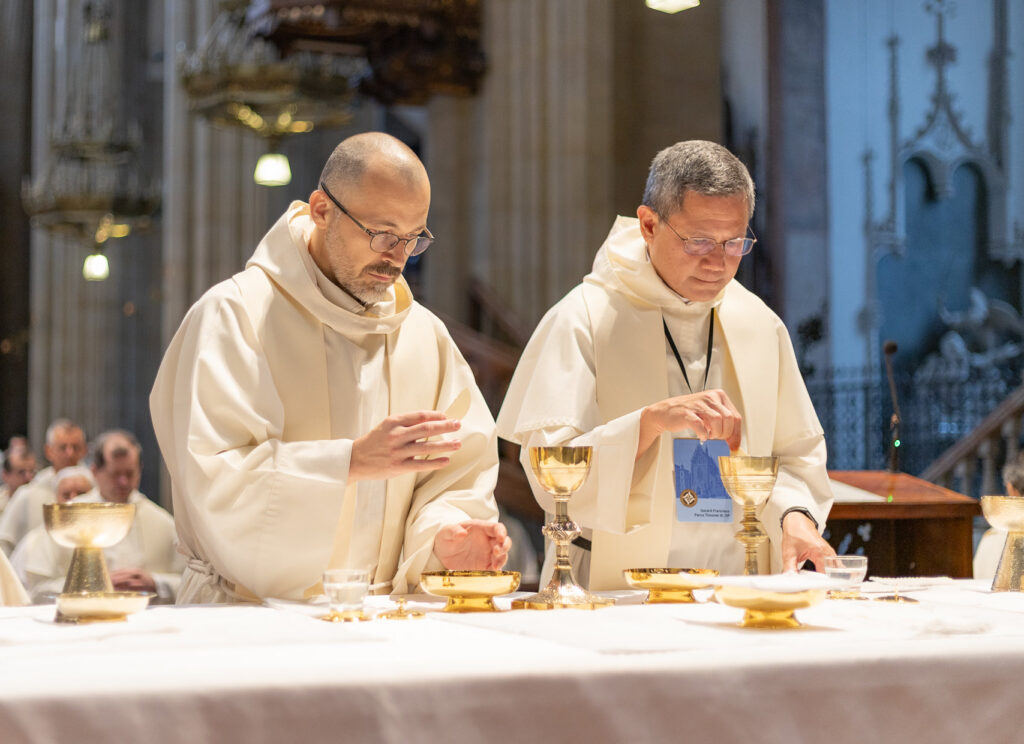
Stephen of Salanhac, OP, once described the Dominican friar as “a canon by profession, a monk in austerity of his life, and an apostle by his office.” Although an apt illustration, Stephen’s words require a fuller explanation.
Dominicans are not quite canons regular (as are the Norbertines), but we do find great joy in the prayerful recitation of the Liturgy of the Hours. All of our priories and communities pray the office in choir, offering our praise to God throughout the day.
Dominicans embrace a life of Gospel poverty and simplicity, just as Benedictine or Trappist monks do, but we are not bound to one cloister. As followers of the Rule of Saint Augustine, and exhorted by Saint Dominic’s last will and testament, we “hold all things in common” (as did the first disciples in the Acts of the Apostles).
Finally, Dominicans share in the office of the apostles by proclaiming the Gospel in every time and place – evangelizing, combating heresy and error, and performing the spiritual works of mercy – but Dominicans are not diocesan priests.
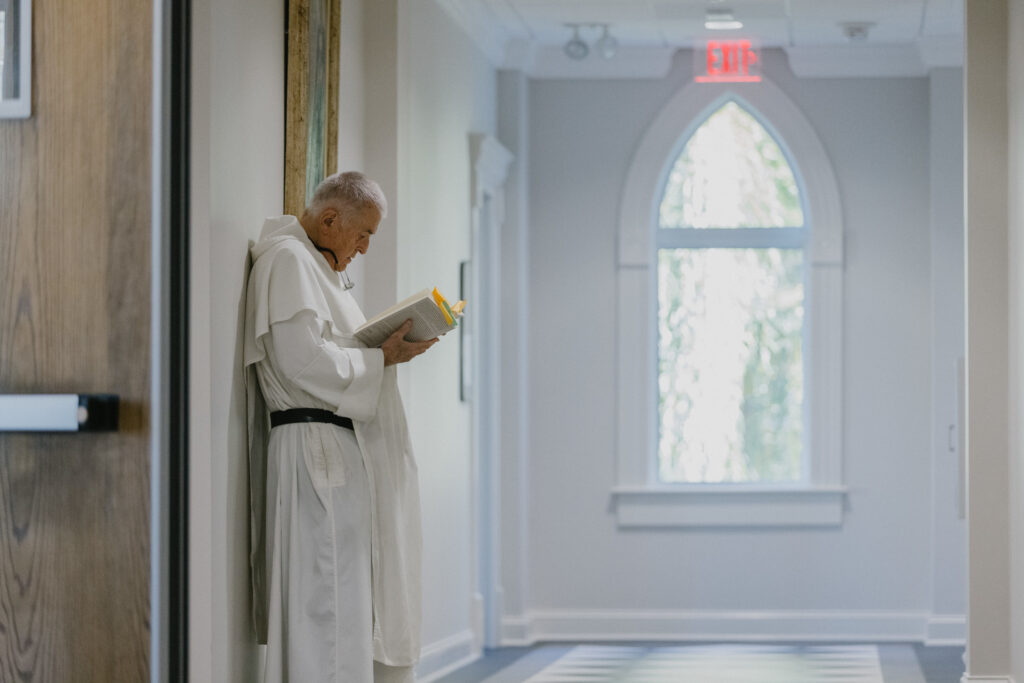
Nourished by our life in common, plus many hours at study and prayer, Dominicans offer our very lives for the sake of preaching the Gospel. What we receive from the Lord, we pass on to others; sharing the fruits of our contemplation, so that all may come to know and love God.
Suggested Reading: Early Dominicans. Selected Writings by Simon Tugwell OP; Darton, Longman and Todd, 1997.
Nourished by our life in common, plus many hours at study and prayer, Dominicans offer our very lives for the sake of preaching the Gospel. What we receive from the Lord, we pass on to others; sharing the fruits of our contemplation, so that all may come to know and love God.
Simon Tugwell, OP, ed.,
Early Dominicans: Selected Writings
— Paulist Press (1982)
Bede Jarrett, OP,
The Life of Saint Dominic
— Cluny Media (2018)
Patrick Mary Briscoe, OP,
St. Dominic’s Way of Life: A Path to Knowing and Loving God
— Our Sunday Visitor (2021)
Paul Murray, OP,
The New Wine of Dominican Spirituality: A Drink Called Happiness
— Burns & Oates (2006)
Saint Dominic and His Mission
— The Catholic University of America Press (2025)
Dominican prayer integrates the Eucharist and Divine Office with contemplative study, directing the heart toward God through the pursuit of truth. It balances communal devotion with private meditation and the Rosary, fostering a personal encounter with salvation. Additionally, the “nine ways” use physical gestures to engage the whole person in worship.
Before founding the Order of Preachers, Saint Dominic was intimately involved in the official prayer of the Church. Everyday he offered the Eucharistic sacrifice, and participated in the Divine Office. Dominic looked to Christ in his perfect prayer to the Father, knowing that it is through such an orientation that mankind begins to be saved. He passed this belief and tradition on to his followers, recognizing that our prayer in common–at daily Mass and in the choral recitation of the Liturgy of the Hours–was necessary for the flourishing of our common life.
In the middle ages, many people saw study as an obstacle to prayer, which was regarded as a pious exercise of the heart. Dominic, however, saw study as an opportunity to enlighten the mind and direct the heart towards God. For the Dominican, study is meant to be contemplative. This is not an emptying of the mind, but a more loving exploration of the created world as it reflects the grandeur of God. In order to do this, one’s mind must first be informed by Christ, as revealed in Sacred Scripture and the writings of the Church Fathers and the Saints.
For centuries the Order of Preachers has promoted the rosary among the faithful, helping establish the Rosary Confraternity and prayer groups around the world. Everyday Dominicans recite at least five decades, fostering devotion to the Blessed Virgin Mary and asking for her intercession. As we pray and meditate on the words and actions of Christ and his mother, we reflect on the mystery of salvation and our mission to proclaim the good news.
In addition to our prayer in common and hours of study, Dominicans spend at least half-an-hour in private meditation each day, usually more. This period of mental prayer often occurs during adoration before the Blessed Sacrament, but may be done at any time. It is an opportunity for lectio divina, spiritual reading, silent reflection, or other devotions.
Still another feature of Dominican prayer is its use of the body. The Eucharistic liturgy, with its delicate blend of movement and gesture, engages the whole person in worship. Dominic incorporated these gestures (standing, bowing, sitting, genuflecting, kneeling, raising his arms) into his private prayer, developing what we commonly refer to as the nine ways. Members of the Order of Preachers continue this tradition today, enriching our common and private prayer
For the Dominican Order, study is a sacred obligation that transforms intellectual rigor into a tool for the salvation of souls and the “formation of the interior man.” Guided by the systematic synthesis of St. Thomas Aquinas, this contemplative practice deepens one’s love for God and equips the preacher to communicate Truth effectively.
Dominican life, modeled on the early Church, centers on being “one mind and heart in God” through common prayer, study, and shared labor. This trinitarian fraternity builds a spiritual foundation that empowers the brothers to witness to and spread the Gospel.
The Dominican Order prioritizes sharing the fruits of their contemplation, acting as spiritual “matchmakers” who guide others toward God. By balancing a deep interior life with preaching, they seek to move both the intellect and the will toward a love for the Truth.