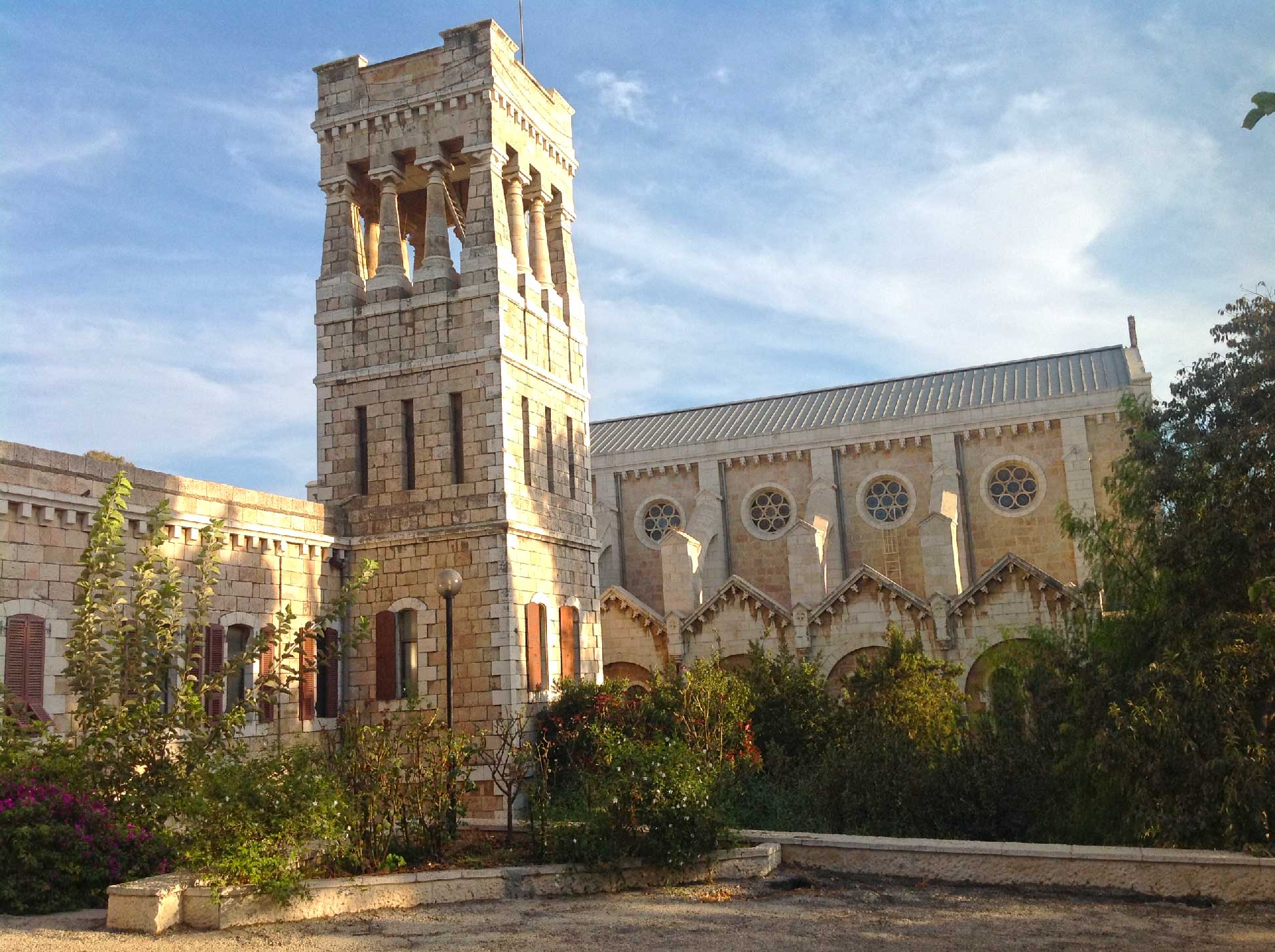

Since its creation, the École biblique et archéologique française de Jérusalem (ÉBAF) has helped to pioneer biblical exegesis and archaeological research in Israel and the neighboring regions.
The founding purpose of the École biblique was to renew biblical studies at a time when modern criticism was challenging the traditional understanding of the sacred text and unsettling the faith of many Christians. For that reason, Father Lagrange wished to advance a faithful yet scientific study of the Bible in the geographic, historical, and cultural context of the land where it was born.
The first team of professors was made up of specialists from the various disciplines necessary for such study. Their competence and the quality of their work soon merited official recognition for the École biblique: in 1920, it was recognized as the École archéologique française by the Académie des Inscriptions et Belles-Lettres. Ever since, the École has thus been named the École biblique et archéologique française de Jérusalem.
The École is situated close to the Old City of Jerusalem, near the Damascus Gate, on the site of a 5th-century Byzantine basilica, built where Christian tradition venerated the martyrdom of St. Stephen the protomartyr: hence the name of the convent, Saint-Etienne (St. Stephen), given to the religious community of Dominicans who run the École biblique.
Since its creation, the École biblique has helped to pioneer biblical exegesis and archaeological research in Israel and the neighboring regions. It has acquired great scholarly renown in the fields of epigraphy, Semitic linguistics, Assyriology, Egyptology, as well as in ancient history, geography, and ethnography.
Inspired by the name of the École Pratique des Hautes Etudes, established in Paris in 1868, fr. Lagrange called his foundation the École pratique d’études bibliques (Practical School of Biblical Studies), in order to emphasize its particular methodology.
The Dominican Priory of St. Stephen of Jerusalem was created in 1882 north of the ancient and beautiful Damascus gate that borders the old town.
On November 15, 1890, in a former Turkish abattoir where rings were still hanging up for the animals, fr. Lagrange opened what he called the École Pratique d’Études Bibliques (Practical School of Biblical Studies).
Its name was changed on October 20, 1920, when the Academy of Inscriptions and Belles-Lettres in Paris recognized the École as the École archéologique française de Jérusalem (French Archaeological School of Jerusalem), because of the quality of its achievements in this field.
Fr. Lagrange gathered and trained an exceptional faculty, including pioneers in Arab ethnography, Palestinian archaeology, Semitic epigraphy, biblical geography and Assyriology.
Among the first friar researchers were Marie-Antonin Jaussen, OP, Louis-Hugues Vincent, OP, Antoine-Raphael Savignac, OP, Felix-Marie Abel, OP, and Édouard-Paul Dhorme, OP, the first scholar to decipher Ugaritic.
Fr. Lagrange founded Revue biblique in 1892, providing a venue for articles and reviews.
During the fifty years (1890-1940) of their intense interdisciplinary collaboration, the members of this small team published 42 major works, 682 scholarly articles, and more than 6200 reviews.
In subsequent decades, the Ecole acquired great scholarly renown in the fields of epigraphy, Semitic linguistics, Assyriology, Egyptology, as well as in ancient history, geography, and ethnography.
The discovery of the Dead Sea Scrolls in 1947 opened a new era in biblical studies, drawing the École into one of the most important manuscript discoveries of the 20th century.
A new generation of researchers emerged, including Bernard Couroyer in Egyptology, Roland de Vaux in biblical archaeology, Raymond-Jacques Tournay in Psalms translation, and Pierre Benoit and Marie-Émile Boismard in New Testament studies.
The famous Jerusalem Bible (French edition, 1956), constituted, as it were, the realisation of fr. Lagrange’s vision.
Among its most recent activities, the École biblique has launched an innovative research program called The Bible in its Traditions.
This project aims to use the extraordinary opportunities afforded by modern technology to construct an online comparative version of the biblical text, presenting its different textual traditions (MT, LXX, Vulgate, etc.), and developing multiple layers of annotation to bring to light the rich reception history of the sacred text in Christian theology and liturgy, in patristic tradition, the history of art, etc.
The École biblique welcomes students with the pontifical license in biblical studies who desire to prepare for a doctoral degree (SSD). The school also receives students at masters level, who wish to specialize in archaeology or the history and geography of the Near East.
Beyond the courses themselves, students have the opportunity each week to visit, with a professor, the main biblical sites in Palestine and Israel. The École has partnerships with various universities abroad, and in Jerusalem it collaborates closely with the Studium biblicum franciscanum.