Dear sisters, dear brothers,
The full-scale invasion of Russia into Ukraine has continued for over four years. Every new anniversary of its beginning has been filled with the hope that it might be the last year of war. Unfortunately, the long-awaited peace still seems distant.
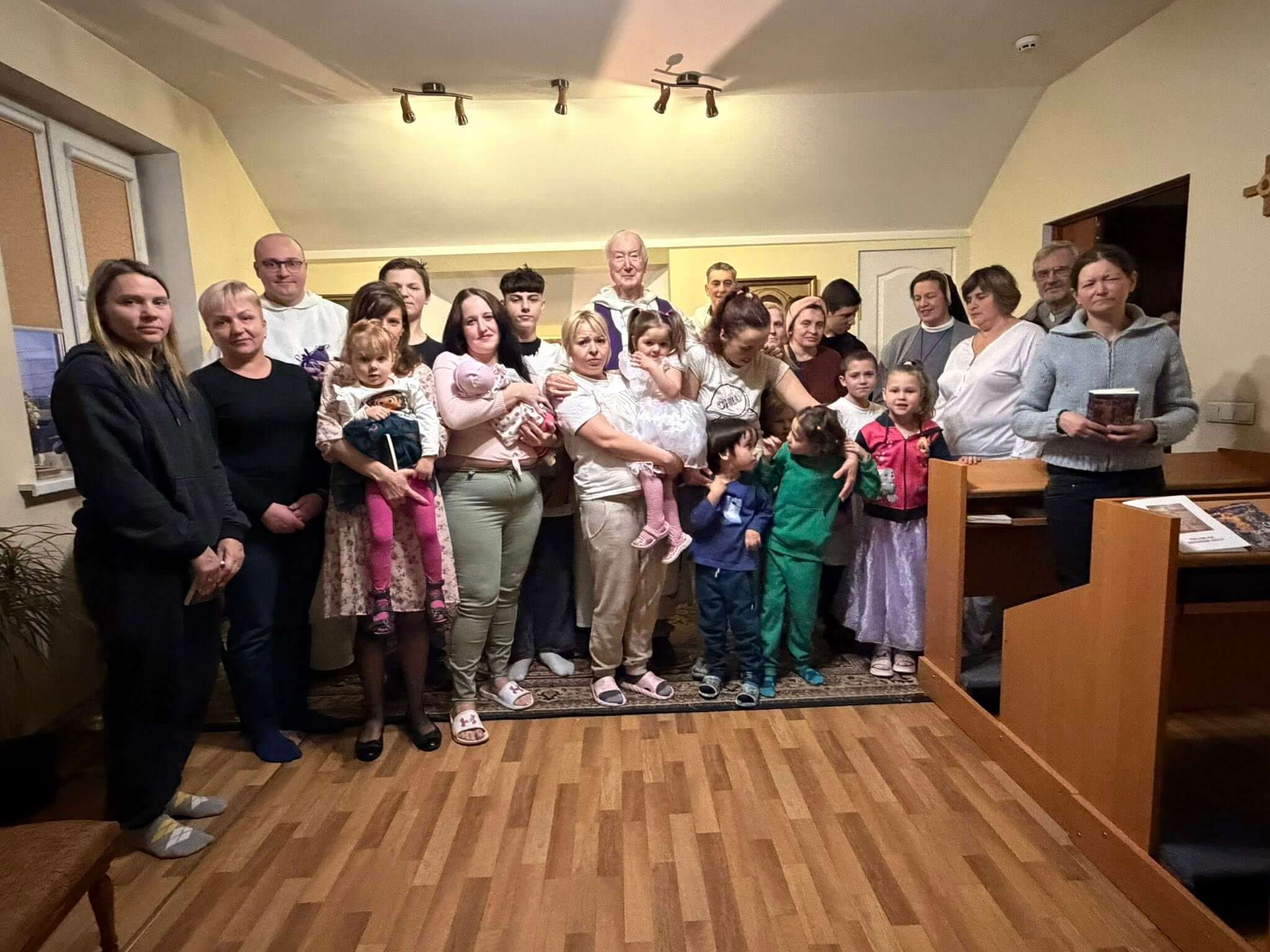
Father Misha showed me a picture taken in Fastiv during the Mass celebrated at the beginning of the war. In March of 2022, people would sleep each night in a tiny chapel in the basement of the parish church. They went there because they felt particularly protected in a holy place. “It is a very telling image of the Church as a space of safety, hope, and trust in God”, added the Dominican from Fastiv. The thick walls of churches give the impression that they can survive the explosions of Russian bombs. People look for safety in places of prayer, and they trust that God is there for the weak and oppressed.
A couple of days ago, Cardinal Timothy Radcliffe, former Master of the Dominican Order and respected author and preacher, finished his visit to Ukraine. Fr. Timothy was accompanied by fr. Alaine Arnould, a Belgian Dominican who lives in Tallinn. “I am very happy that I could be here again. It’s not that I have some particular wisdom to offer. Rather, every time I visit places marked by suffering and war, I receive much more than I give and learn more than I teach. I came here primarily to be with my brothers and sisters,” fr. Timothy said in Kyiv.
I was able to see the true depth of these words when I accompanied fr. Timothy and fr. Alaine in various meetings and many prayers in both Catholic rites as we traveled through Fastiv, Kherson, Odesa, Kharkiv, and Lviv.
A visit to Kherson
When we were planning Cardinal Radcliffe’s trip to Ukraine, we were a little audacious when we suggested an excursion to the southeast of the country to Kherson. On the other bank of the Dnieper River, across from where the city is located, there is a territory that has been occupied by the Russian army since 2022. The city itself has been under artillery fire every day. Recently the city has become even more dangerous because small drones, often with an explosive payload, constantly patrol over the city and are a serious threat to everyone living there. We were able to experience it when we went for a short walk around the church and the parish buildings. As soon as we stopped for a moment, we could hear a distinct sound of a drone’s engine, and the local pastor, fr. Maxim, helped us to immediately find shelter.
When I wrote to fr. Timothy in mid-January asking if he would be open to joining us on our trip to Kherson, his response was swift: “I have read of their sufferings, and it is important to be present with them and show they are not forgotten. So let us proceed with this visit! If someone who is 80 years old and has no dependents cannot take risks, who can?”
So, we went and spent three days there. For the past couple of years, our foundation of St. Martin de Porres in Fastiv has been running a kitchen in Kherson for people in need. Volunteers prepare and distribute hundreds of hot meals every day. They also provide a laundry facility that can be used free of charge, distribute food supplies, and in many ways serve the people who despite air raids and shellings still remain in the city and surrounding villages.
A visit for solidarity and hope
The visit of Brothers Timothy and Alaine was not by chance. We had wanted, even for just a moment, to be together with our coworkers, volunteers, and all those who receive our help. It was intended to be a clear sign of closeness and Christian solidarity. “During the Holy Mass, the cardinal said in our church that we were not alone. Those were very important words for us, and they were a sign of support in this difficult time when many of us feel alone and empty,” said fr. Maxim when I asked him about the meaning of our visit. “Not many people nowadays have the courage to visit us,” he added.
The church in Kherson is located near the river in an area frequently shelled by the Russians. The neighboring buildings are mostly destroyed or damaged, along with the parish center. People rarely appear on the streets. They are mostly elderly people who decided not to leave their homes. We met a man walking his dog. He approached us, offered a polite greeting, and tried to start a short conversation in English. I had the impression that it was important to him that someone came to visit from far away. During the war, one of the most difficult experiences is loneliness and the feeling of abandonment. It goes a long way when someone shows closeness and solidarity, even in the smallest way.
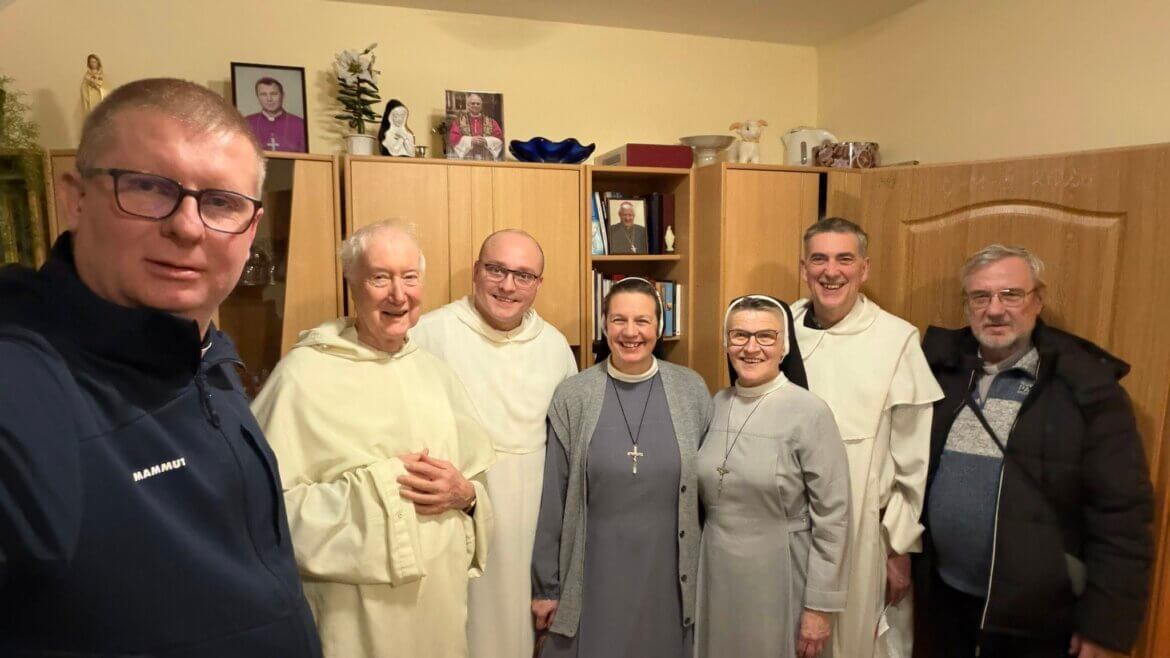
When we were entering the Carmelite monastery in Pokotylivka near Kharkiv, fr. Timothy noted: “The sisters’ faces are full of light and joy.” This is one of the two existing contemplative Carmelite monasteries in Ukraine.
Prayer and the long work of forgiveness
On February 24, on the fourth anniversary of the aggression against Ukraine, we read during the Mass a Gospel reading about Jesus teaching us to pray the “Our Father” (Mt. 6:7-15). Before the visit, fr. Timothy had chosen this as the theme of the retreat that he would preach in Kyiv to the Dominican family. I am convinced that this was not accidental and that the words of the “Our Father” will show us the way to the future. These are amazing words that touch everything that is important, even the difficult subject of forgiveness, as Cardinal Radcliffe said: “You will surely find it very hard to forgive. Also, things happen inside families which are difficult to forgive. (…) We cannot be forced to forgive by a threat. All we can do is to pray that one day forgiveness will become possible. It cannot be forced any more than we can force flowers to bud or the sun to shine. We should be patient with ourselves. We pray that we shall be able to forgive, and this may take a long time. What matters is that we hope to, even if we cannot now forgive. (…) We may not be able to forgive someone personally. The hurt and anger may be too raw. But we pray that the Church will forgive. ‘Look not on our sins but on the faith of your Church,’ we say in the Eucharist. So St. Thomas Aquinas says that we don’t lie when we say in the Lord’s prayer that we forgive those who sin against us, even when we feel no forgiveness and when forgiveness seems impossible. He says: ‘I answer that he [who says this prayer] does not lie, for he is praying not in his own person, but in that of the Church.’”
For many years, the Orionine sisters have been running a house in Krotych near Kharkiv for single mothers who are in difficult situations in life. Their house is a beautiful sign of evangelical love. During dinner with Brs. Timothy and Alaine, we heard many stories of how God takes care of us through good people. We also had the opportunity to return to the meditation preached by Cardinal Radcliffe during the Synod of Bishops in Rome in 2023. On that occasion, he had told a story from the first days of war: “One of my brothers in the east of Ukraine went to say Mass for some sisters who were moving. Everything was packed. All they could offer for the paten was a red plastic plate. He wrote: ‘This was how God showed us that he was with us. ‘You are sitting in a basement, in the damp and the mould, but I am with you — on a red child’s plate, and not on a golden paten.’”
“Would you like to see that red children’s plate?” sister Kamila asked us after our Mass. I was deeply moved as I held this “precious” plastic object. I immediately handed it to fr. Timothy.
I would like to thank all of you for praying for peace and for your support that you offer to Ukraine. We experienced it particularly deeply this winter when Russian rockets and drones destroyed the electrical grid and cut off heat for our cities. The attacks occurred during the coldest days when temperatures fell at night to -20℃ (-4℉). Those were traumatic weeks for hundreds of thousands of people in Kyiv and other cities. How can one survive in an apartment that has a temperature of 5℃ (41℉)? Fortunately, the spring is coming, and it’s getting warmer. The shining sun of spring reminds us of hope.
This time, I wrote this letter not from Kyiv but from Fatima—a place submerged in daily prayer for peace. And we constantly ask you, too, for that prayer.
With fraternal greetings,
Jarosław Krawiec, OP
March 20, 2026