Interview with Fr Jorge Alejandro Scampini, OP, Master of Sacred Theology (Magister in Sacra Theologia)
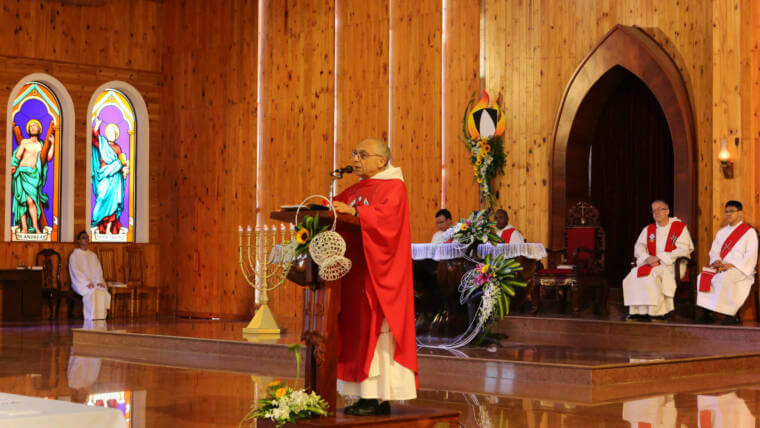
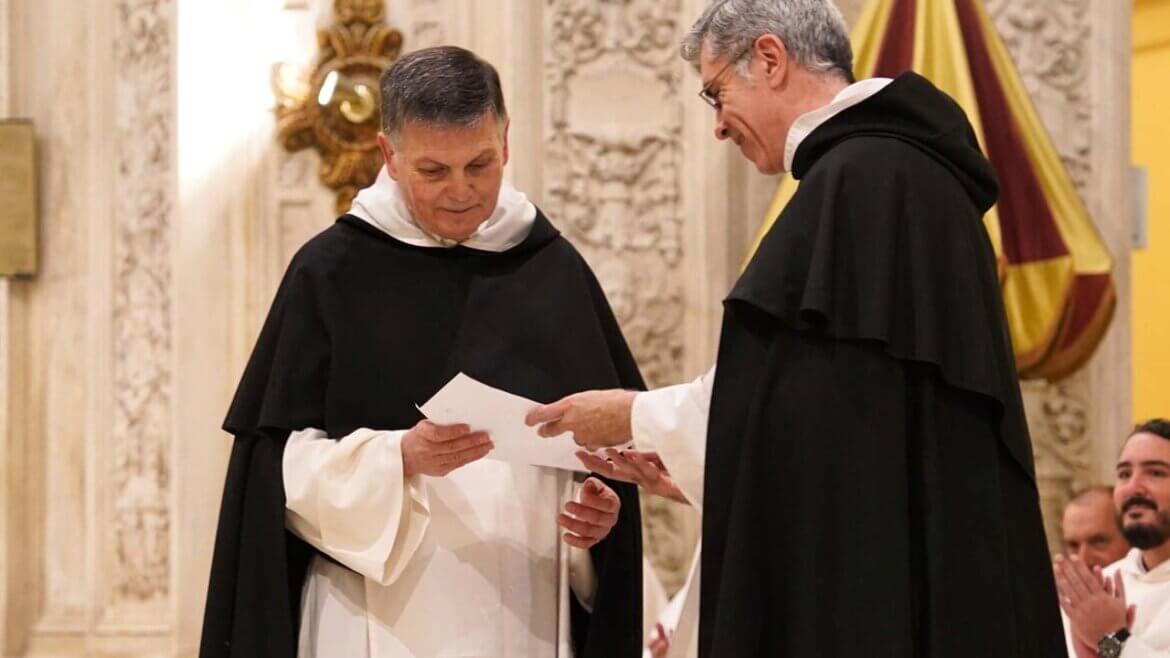
Friar Jorge Alejandro Scampini, OP, of the Argentine Province of St Augustine, was granted the degree of Master in Sacred Theology (Magister in Sacra Theologia) by the Order of Preachers, by decree of the Master of the Order, Friar Gerard Francisco Timoner III, OP, on 22 November 2024. He affirms that in today’s complex world—marked by technological dominance and seemingly limitless bioethical research, where humanity itself is at risk—these issues can no longer be addressed solely from a theological standpoint. Rather, they demand an interdisciplinary approach, particularly from a philosophical perspective. Despite numerous “advances”, some of them “ambiguous”, the question of life’s meaning remains the fundamental question for every human being. “In an increasingly globalized world, we must continue to discern what these quests for meaning are and how to be preachers of the Good News,” he says in the following interview with Ordo Praedicatorum.
Master in Sacred Theology1
What does it mean to you to have received the degree of Master in Sacred Theology from the Master of the Order?
First of all, it led me to question my identity and my service in the Order—this is no exaggeration. I must admit that my initial reaction was to consult the Book of Constitutions to objectively verify the meaning and requirements of this title. Reflecting on my personal journey, I asked myself whether I had truly fulfilled what is stated in LCO 96, since in academic circles, the value of one’s contribution is judged by results, especially the quality of publications. Academic institutions invest accordingly, because that is how they are assessed. From this perspective, I am keenly aware of the limitations of my theological work—limitations that stem from personal circumstances, divided commitments, and the fragility of the institutional settings in which I have worked. This is not an attempt to justify myself, but rather to point out that it is precisely these challenges that have made me more sensitive to another essential aspect: the truly “vocational” dimension of the service to which we friars are called, which is the source of our commitment and its deepest rationale. In this sense, the fact that the title is conferred by the Order itself made me realize that it is, above all, a recognition by my peers—who may have valued what I have offered within the Dominican project, particularly in the theological formation of friars in my Province. To be honest, if I have contributed anything in the intellectual sphere, it has been as a friar, thanks to what I have received from the Order and in obedience to other responsibilities in the common life and the Province. I believe it is significant that, through this internal service, I was able to contribute something to the broader ecclesial academic world—teaching in institutions outside the Order or engaging in theological dialogue with other Christian traditions. For this reason, I experience this recognition with gratitude to the Order, acknowledging all that I have received from it.

In your opinion, what would be the Order’s current theological proposal to the Church and the world?
There is much to say on this subject, especially if we consider a proposal that truly embraces both the Church and the world—particularly the world, which presents increasingly complex and challenging realities. I also speak from my own context, which by no means exhausts the reality of the Church or of the world. For that reason, I will limit myself to two aspects. First, following the acts of the general chapters—as far as this governing body’s discernment can reach—the issue of the challenges and frontiers of our preaching has always been present. There has been talk of priorities (1977), of frontiers (1986), and more recently, of the various audiences of our preaching. These different points of reception demand solid theological foundations and call for creative theological reflection. In a sense, it is these concrete encounters that set the agenda. But how can we address this challenge as Dominicans, drawing on the best of our tradition? I believe a key feature of our theological and philosophical heritage—rooted in the intuition of Saint Dominic and given theological structure by Saint Thomas—is the appreciation for the order of creation. This perspective is also present in the conciliar vision of the Church’s relationship with the world. In a world as complex as ours—vastly different from sixty years ago, with the dominance of technology and seemingly limitless bioethical research, where even human nature is at stake—it is no longer sufficient to approach such issues only from a theological angle. They demand an interdisciplinary response, and especially a philosophical one. This requires collaboration with others—both friars and non-friars. The Order is called to this task as a societas studii, a compelling image that can take shape in different ways. For more than a decade now, we have had the vision of the Salamanca Process, but I have the impression that we have not yet taken full responsibility, as an Order, for the potential it contains. We still need to put in place the means to generate processes of reflection in diverse contexts, respecting the priorities and boundaries of each geographical, cultural, and social area. What I have just said must not obscure the central content and ultimate goal of our preaching: the explicit proclamation of Christ for the salvation of souls, and the ever-deepening understanding of the mystery of the Incarnation. Despite all the “advances”, some of which are “ambiguous”, the question of life’s meaning remains the fundamental question of every human being—whether they can articulate it or not. In my own context, I’ve been haunted for years—since before completing my first theological cycle—by a question that arose in the peripheral neighborhood where I was engaged in pastoral work. It was sparked by the presence and activity of Pentecostal groups: how is it possible that those who have distanced themselves from the Catholic Church now feel subjectively closer to Christ? This is a question about Gospel preaching and the way the Church carries it out. It challenges us—as it challenges the whole Church—on the effectiveness of our “specialty”. In an increasingly globalized world, we must continue to discern what these quests for meaning are, and how we are to be preachers of the Good News. On these two fronts, I believe the Order has a rich tradition—one capable of renewal in response to new situations. We have a vision of study directed toward preaching and a recognition of the gifts of nature and grace present in each brother. The Order’s theological proposal—or proposals—can be discerned, shaped, and offered in the measure that we are able to bring forth the best of the treasure entrusted to us, integrating and enhancing all resources, without losing the realism that has always characterized Dominican life. And all this must begin already in institutional formation.
What could be the Order’s contribution to ecumenism in the 21st century?
What I have just said also applies to our ecumenical service. In this area, our tradition brings with it the richness of a true “tradition”, one that began to take shape with pioneers—most clearly with Fr Yves Congar, though not with him alone—and from which later generations have drawn much. In the third decade of the 21st century, we are more aware that ecumenism is not a specialized field—though the methodological tools proper to dialogue remain important—but rather a transversal reality, cutting across multiple domains. This implies that even dogmatic topics require insights from a variety of theological and non-theological disciplines. Much progress has been made in theological dialogue in recent decades, but challenges remain, particularly in the area of reception—that is, the steps to be taken within each Church to assimilate what has been achieved. In this regard, Dominicans have provided solid contributions rooted in Tradition—nothing superficial or relative—regarding the Church’s self-understanding, and these contributions point to paths of renewal and reform within the Catholic Church. However, the situation is not straightforward. I would identify three complex factors that challenge a global Order such as ours. First, there is the diversity of interlocutors, whose differing ecclesiologies mean that not everyone understands the goal of the ecumenical movement in the same way. This requires having “agents” who are especially competent in a particular area of dialogue—be it with Eastern Churches, the Magisterial Reformation, Free Churches, or charismatic communities. Second, in global contexts—which are increasingly the norm—universal statements, whether explicitly formulated or not, must be verified on the ground. That is, dialogue must also take place at the local or regional level. Third, we are witnessing a shift: divergent issues have moved from the dogmatic-doctrinal to the ethical realm, where Christians now often present fragmented or even contradictory positions. This shift calls for a new profile in the formation of those engaged in dialogue. The demands are many, and they require a variety of agents.
How has ecumenical work developed and is developing in your country?
Ecumenical activity in Argentina has gone through various stages and taken different forms. I can speak personally about what has happened in the last forty years, while also sketching the overall trajectory. In the decades immediately following the Second Vatican Council, given Argentina’s immigrant population—including many non-Catholics—the presence of various Eastern Churches and Protestant communities enabled a form of ecumenism centered on encounter, spiritual emphasis, and limited academic collaboration. However, doctrinal dialogue was not implemented. From the 1970s—and more clearly in the 1980s—a shift occurred, accompanied by a crisis. Catholics and Protestants together chose to move closer through the lens of liberation theology and concrete social commitment. This opened up new areas of engagement: witness, joint service, and efforts for justice and peace. At the same time, it produced fractures both within the Churches and in their ecumenical relations. Since the 1990s, a certain rebalancing has taken place. Over the past few decades, this has led to what I would call a “plateau”: relations are good, but there is little interest—especially on the Protestant side—in moving toward unity in faith. This is no longer seen as a priority. Moreover, there is no real discussion on ethical issues, where positions are already quite defined and divergent. For all involved, the unacknowledged challenge remains the rise of Pentecostalism, which has grown largely at the expense of the Catholic Church and the historic Protestant Churches. The capacity to respond has been virtually non-existent. Initially, there was a failure to recognize the pastoral challenge that Pentecostalism represented, and to consider what the established Churches—including the Catholic Church—were offering their faithful to remain within the fold. Today, we face a new challenge: with many of these groups now relatively stabilized, how do we establish an “ecumenical relationship” with them? This second challenge points to the need to develop a form of ecumenism with a truly Latin American face.
- It is an honorary title conferred by the Master of the Order, following the recommendation of the General Council and in accordance with certain requirements established for its granting. The title dates back to 1303, when Pope Benedict XI—a Dominican—created this degree so that the Order of Preachers could confer the faculty to teach theology. Today, it is an honorary and exclusively academic title, but it remains the highest recognition of excellence in the sacred sciences within the Order of Preachers. ↩︎

Fr. Jorge Alejandro Scampini was born in 1957 in San Antonio de Areco, Argentina. After completing studies in law, he entered the Order of Preachers in 1980. He made his solemn profession in 1984 and was ordained to the priesthood in 1987. He completed his institutional studies at the Centre for Philosophy and Theology at the University of North Saint Thomas Aquinas, obtained a Licentiate in Theology from the Angelicum in 1990, and a Doctorate in Theology from the University of Fribourg in 2001. Upon returning to Argentina, he held several roles: Moderator of the Centre for Studies, Regent of Studies, Promoter of Ongoing Formation, and Conventual Prior in Buenos Aires. He also served on the De Missione Ordinis and De Promotione Studii Commissions. For over thirty years, his academic work has been rooted in the Province’s Study Centre, where he teaches Dogmatic Theology and oversees ecclesiology, sacramental theology, Marian theology, and ecumenism. He is a full professor at the Faculty of Theology of the Catholic University of Argentina and has taught in various seminaries and institutes. He has served as vice-president and president of the Argentine Society of Theology and is a consultant to the Vatican Dicastery for Promoting Christian Unity.