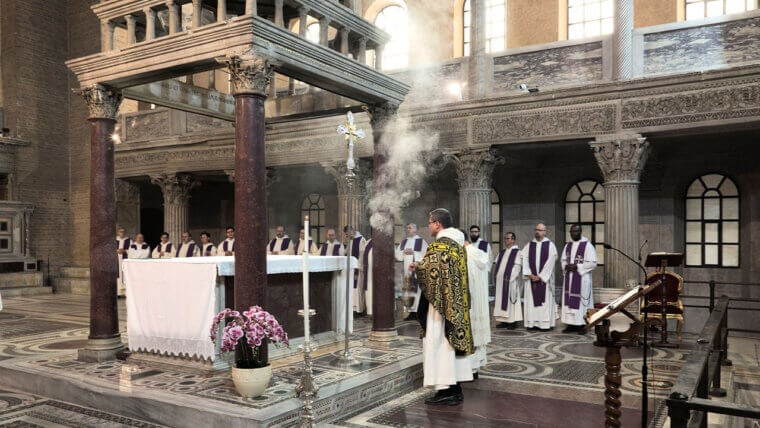
The following homily was preached by the Master of the Order, Gerard Francisco Timoner III, OP, during a fraternal visit to the Monastery of Santa Maria della Neve.
Perhaps some of you have wondered why today, in this splendid monastery, there are so many friars. It is certainly one of the rare occasions when Dominican friars outnumber the nuns in a monastery! We come from the General Curia of the Order in Rome and are here for our annual community outing. This initiative is inspired by a passage from the Gospel of Mark, in which Jesus invites the Twelve to step away for a while from their occupations to withdraw to a secluded place and rest a little.
Yesterday we went to Arezzo, to the Basilica of St. Francis, where we contemplated the Legend of the True Cross by Piero della Francesca. The central theme of that work is precisely the cross as a sign of salvation and a guide in humanity’s spiritual journey. That visit formed part of our preparation for the feast we now celebrate together today, in this beautiful monastery of our dear sisters of Pratovecchio.
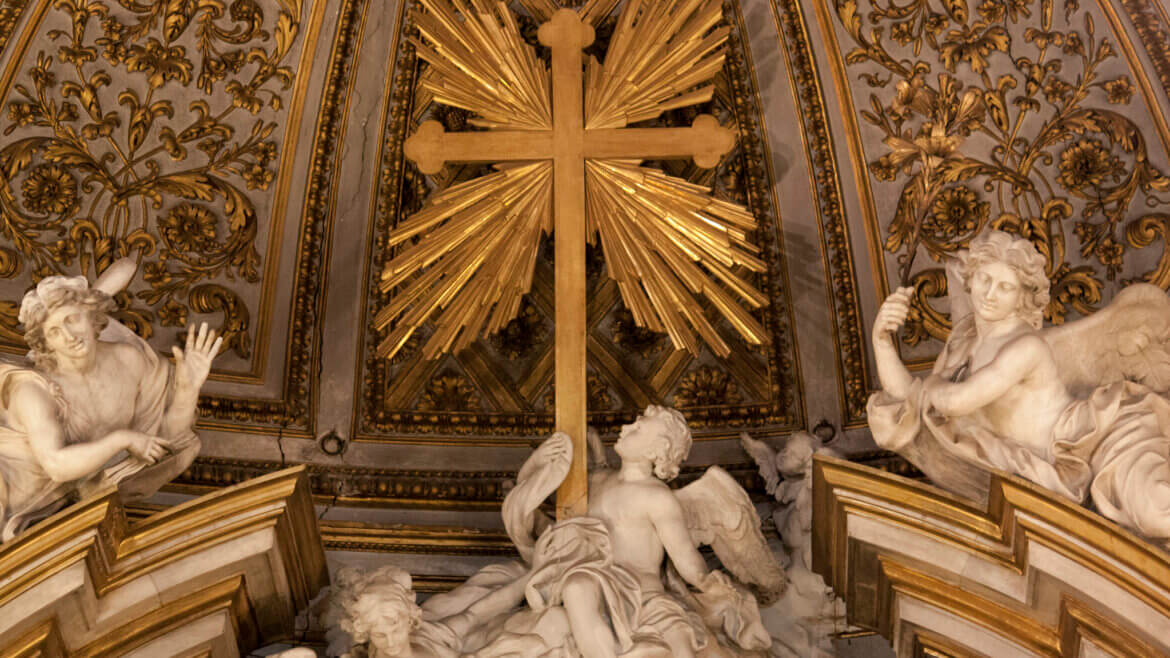
The feast of the Exaltation of the Cross invites us to consider the cross of Christ as the center of human history, the place where the love of God triumphed over darkness. An instrument of oppression and humiliation, the cross, in God’s hands, became the sign of victory: there Jesus disarmed evil, reconciled us with the Father, and opened for us the way to eternal life.
The logic of the Cross
The newness of the Cross lies in the overturning of human logic. Earthly power seeks to dominate, to impose itself, to eliminate the adversary. But in the Crucified One, God reveals to us a different logic: true power is love that gives itself and empties itself. The Cross is exalted because it unmasks the illusions of worldly strength and reveals that divine omnipotence is not control but compassion; not violence but mercy.
Just as in the desert Moses lifted up the bronze serpent and whoever looked at it found life (Nm 21:9), so the Son of Man, lifted up on the Cross, becomes for us a source of salvation and healing (Jn 3:14–15). Salvation is not an external remedy added later; salvation springs from the very wound of love. The pierced side of Christ is not proof of defeat but the open door through which the life of God enters the world.
Entering the mystery of suffering
To exalt the Cross, therefore, does not mean to glorify suffering for its own sake, nor to indulge in a romanticism of pain, but to recognize that God chose to reveal himself at the very point where love costs everything. The Cross teaches us that love without sacrifice is mere sentiment; love that suffers and gives life, instead, becomes redemptive.
And this concerns us as well: every cross we bear, whether small or great, can become a participation in this divine logic of love. United to Christ, our cross is no longer just a burden or toil, but becomes a sign of the glory of God: there our weakness is transformed into strength, and even death itself becomes a gateway to life.
Therefore, the Exaltation of the Cross is not so much the contemplation of wood and nails, but the recognition, through them, of the very heart of God. It is the feast of the “new logic” of his Kingdom: where loss becomes gain, surrender becomes victory, and death opens to eternal life.
Jesus invites us: “Take up your cross and follow me” (Mt 16:24). We often imagine this cross as something external, like a backpack, something we can choose to carry or to set down. But we must not forget that the sign of the Cross was imprinted on our forehead and in our soul on the day of our baptism. With that sign, through the power of the Holy Spirit, the Father adopted us as his sons and daughters. To take up the cross, therefore, does not mean to pick up a burden left on the ground, but to remain faithful to the cross that was given to us at baptism. It is an invitation to remain firm in our baptismal promise: to follow Jesus and reject evil, so as to live in the light of his victorious love.