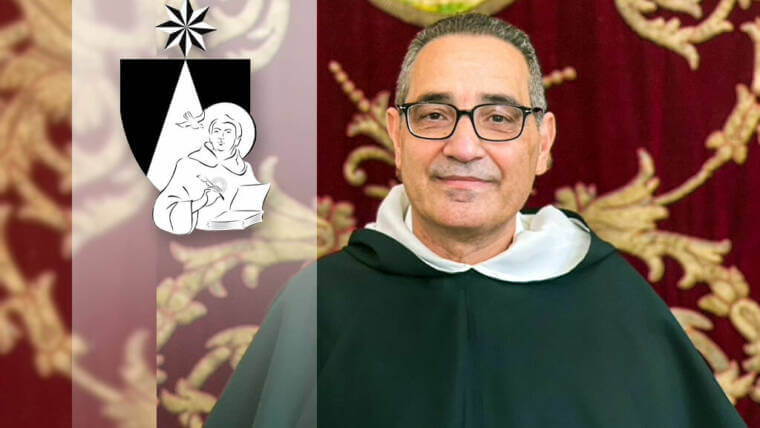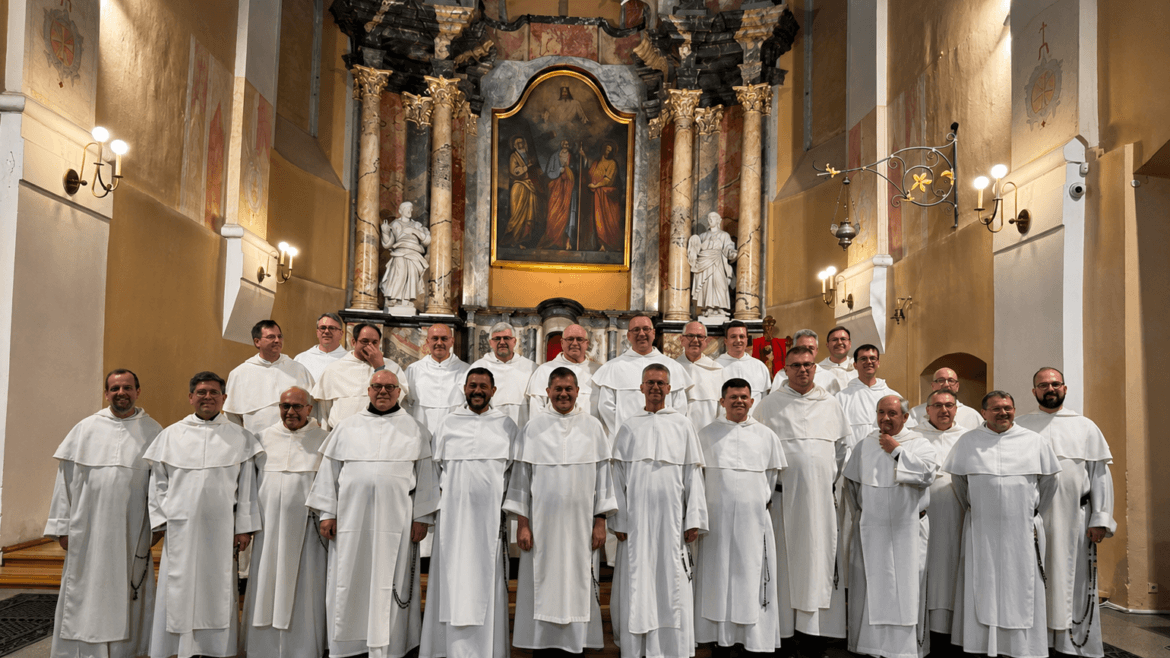
The following homily was preached during a liturgy by the Master of the Order which took place during the Inter-European Meeting of the Order of Preachers (IEOP). The meeting is held annually the week after Easter and was hosted this year in Vilnius, Lithuania.
One of humanity’s great afflictions is forgetfulness. Because we forget the lessons we have learned, we repeat our mistakes; which is why humanity falls again and again into conflict and war. The antidote to forgetfulness is anamnesis, remembrance. Perhaps this is why Scripture continually urges us: “Remember the wonders the Lord has done.” And at the very heart of the Eucharist; the celebration of Christ’s abiding presence; we hear His command: “Do this in memory of me.”
In the Gospel of John, the evangelist frequently uses subtle details to evoke memory, almost like spiritual flashbacks. Simon Peter, Andrew, James, and John first encountered the Lord after a long night of fruitless fishing. In today’s Gospel, that same experience recurs, it must have felt like déjà vu. Another detail carries even greater weight: when Peter denied Jesus three times, he stood warming himself beside a charcoal fire. Now, meeting the Risen Lord, he finds a charcoal fire once again, a quiet, wordless reminder of what he had done.
We recall that when these disciples were first called, they left everything: their boats, their nets, their very identity. They stepped into something new, uncertain, yet full of promise. “I will make you fishers of men,” the Lord had said.
But after the crucifixion, everything seemed shattered. The one they had trusted was gone; the future they had imagined had collapsed; the clarity of their calling had faded. So they did what many of us do when we feel lost and discouraged: they went back to where they were before they met Jesus. They returned to the sea, to the boats and nets they had once left behind, trying to gather the pieces of a hope that, in their eyes, had gone unfulfilled.
This is where the Gospel draws very close to our own lives. There are moments when faith feels exactly like this, when something we once believed in deeply seems to fall apart, when our sense of purpose grows dim, when hope is interrupted by disappointment or loss. In those moments, we instinctively retreat to the familiar, to what feels safe. We want to reboot, to start over.
Yet the Resurrection account we hear today speaks a powerful and consoling truth: even when we return to our old lives, Christ does not abandon us. The disciples go back to fishing, but Jesus comes to find them. He meets them in their confusion, standing quietly on the shore of their in-between lives. There, they discover something important. Returning to their former way of life, they find no fulfillment in it, they catch nothing. It is as if the Gospel is telling us: once you have been called by Christ, you can never fully return to who you once were. What once gave you identity now feels hollow.
Then comes His simple command: “Cast the net on the right side of the boat.” This marks a decisive turning point. It reveals that fruitfulness comes not from effort alone, but from obedience to the Word. The same nets, the same sea, the same men, yet now, guided by His voice, their work becomes fruitful beyond measure. Here we glimpse a deeper truth about the Church: her mission does not arise from human strategy, but from attentive listening to the voice of the Lord. And perhaps this is the most important lesson of all. Peter, Andrew, James, and John did not need to rebuild their lives from scratch. They needed only to recognize that Jesus was still present in what had felt like an ending. Dominus est! It is the Lord!
When we find ourselves at what seems like a dead end, when the only path appears to lead back to who we once were, we should not conclude that the story is over. Christ is already there, waiting for us. Not to remind us of our failures, but to call us once more to the same vocation: to be fishers of men, to share in His mission, to feed His flock.
Then John does something that, from a literary standpoint, might seem almost unthinkable: he mixes metaphors within a single narrative. First, Jesus tells Peter to cast the net to the other side; then, after a breakfast of fish and bread, He tells him to feed His sheep. The shift from fisherman to shepherd might appear an awkward mixing of images, but in fact it is deeply instructive, particularly for us Dominicans. Every preacher is first called to catch, to proclaim the Gospel and draw others to Christ; and then to feed: to form, guide, and pastorally care for them. Within the Church, we sometimes tend to separate these roles, treating the fisher of men and the shepherd of souls as distinct vocations. But a careful reading of John 21 reminds us that they are not opposing tasks; they are two inseparable dimensions of the one apostolic mission.
And so, in this Eucharist, we pray for the grace to listen attentively to the Risen Lord, to discern where he is calling us to cast our nets, and to recognize that the true measure of our love for him is found in feeding his sheep.