“He did not work many miracles there because of their lack of faith”
(Matthew 13:58)
Memorial of Saint Alphonsus Liguori
Texts of the day:
Lev 23:1, 4-11, 15-16, 27, 34b-37
Mt 13:54-58
Dear brothers and sisters:
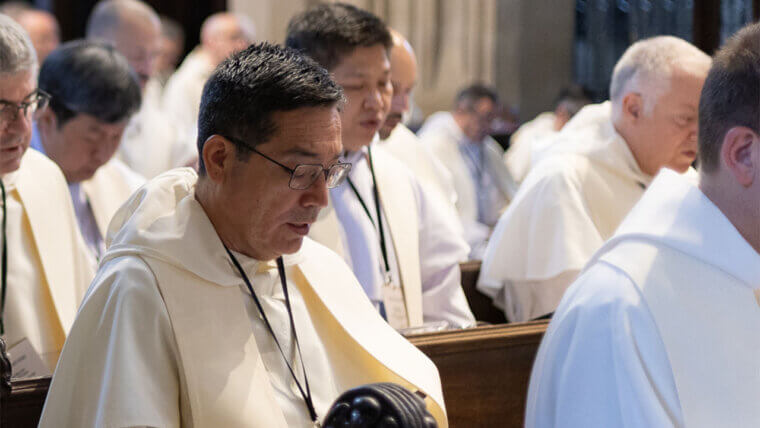
As we gather for this General Chapter, the Word of God presents us with two complementary images: on the one hand, that of unbelieving Nazareth, which rejects God’s visit in the person of Jesus, and on the other, the inhabitants of the people of Israel called to celebrate the sacred feasts.
Jesus teaches with authority, marvels with his works, but is not received. Those who were closest to him did not believe in him, for he seemed too familiar, too “ordinary,” and they failed to recognize the One who is the reason for every solemnity and religious celebration, that is, God Himself. These people, who knew the law and the feasts, failed to see that every Passover, every synagogue, every sacrifice points to God and must always lead us to Him.
We heard in the first reading that it is the Lord God who organizes the life of His people with a holy rhythm: Passover; Pentecost; Day of Atonement; Feast of Tabernacles, among other celebrations. This means that we should always keep in mind that every solemnity is a reminder that time belongs to God, that history is not abandoned to chaos, but is a history of salvation. Night is a time of salvation, as we sometimes sing when we pray Compline.
As I read the texts to prepare this reflection, the thought came to me that each member of the Order of Preachers draws from those two realities of which the Word of God speaks to us today: an Order that upholds tradition and celebrates the faith, like the inhabitants of Israel; and an Order that, like Jesus, must dare to enter even today into the harsh, indifferent, and perhaps even hostile, “Nazareths” to preach the message that proclaims the friendship of God and invites us to constantly return to him.
Last Sunday, July 27, we went to Auschwitz/Birkenau, and I was speechless to comment on what I heard, what I saw, and what I felt there. I confess that I remain shocked, astonished, and scandalized. Definitely, self-dehumanization always leads to an unbridled desire to destroy others totally.
Dear brothers and sisters, in our world today shaken by the scandals of some members of the Church and of our own Order—as well as by political, economic, and abuses of power, in addition to hatreds, corruption, violence against creation, invasions of other countries, political interference, war, and destruction of life—we need celebrations of hope: places of hope, times and words that interrupt the routine of despair. This is where our preaching is called to heal the wounds of today’s world “with the oil of consolation and the wine of hope.”
But today, just as happened to Jesus in Nazareth, there will surely be people who will look at us with indifference and ask suspiciously: Are not these the same old friars preaching? What new message can they tell us?
Faced with the discomfort of these questions, let us remember that our Father, Saint Dominic of Guzmán, teaches us not to remain silent, because we are not preaching a human novelty, but Jesus Christ, the eternal Truth, always new. The first disciples of Jesus, after the event of the Resurrection, already said: “We cannot keep silent about what we have seen and heard.” We too cannot remain silent, and we know perfectly that our silences, often, are not meant to enter into a sense of prayer and contemplation, but rather to avoid confrontation or to avoid making anyone uncomfortable.
And so, we who exercise the ministry of the word and preaching, what paths should follow today?
I can think of at least four:
• The path of study and contemplation to proclaim that every Easter, every Eucharist, every celebration of faith is more than a rite: it is the living presence of the One who continues to pass through our peoples, our countries, our lives, our homes and convents, and this General Chapter. Our theology must engage with the cries of the world, the climate crisis, dictatorships, wars, and injustices so that no one may say, “Where does this friar, this nun, this sister, and these lay Dominicans get this wisdom?” But rather that they may recognize Jesus Christ in our words and actions every day.
• The path of pastoral renewal and/or the renewal of the Dominican preaching project that allows us to go where faith has become an empty custom, a practice of stale and empty rites, beginning in our own home. In this way, we will succeed in igniting the spark in the Nazareths of this 21st century: monotonous parishes, tired religious communities, young people disillusioned in our educational centers, friars wearied by their own brothers, non-religious and agnostic friars. We must approach these places and people, emulating the tenderness that Dominic of Guzmán showed among heretics and the poor, being clear that rejection can occur, as well as persecution and martyrdom itself. Jesus already said to his disciples: “I am sending you out as sheep among wolves.” This pastoral renewal demands that we be men and women of audacity and compassion, who must learn from Jesus of Nazareth.
• The path of spiritual renewal to renew our communities so that every convent and house may be a holy tent where friendship, prayer, study, mission, and community life are celebrated. Dear brothers and sisters, without fraternal life, without prayer, without study, and without community, miracles will not be possible, but only unbelief. We are called to be visible signs of the feast that is the Risen Jesus Christ.
• The journey of reviewing our lives: what signs of the Gospel do we offer to people today? The miracle of preaching does not depend solely on words, but on the relationship with the living faith of the listener and the holiness of the preacher. Faced with this journey, I propose that we ask ourselves the following question: Could it not be that sometimes our familiarity with the Gospel makes it “insipid” for us? Is there not something of Nazareth in our communities as well, when we grow accustomed to routine, to what is “already known,” to the comfort of what is established?
The text from Saint Matthew that we heard today tells us that in Nazareth there were not many miracles because people did not accept the possibility that Jesus was the bearer of God, much less that He was God. May it not be so among us! May this General Chapter be our book of “renewed Leviticus,” may it continue to be the great feast of the gathering of brothers and sisters where together we take the pulse of our life and mission. May what we live in this General Chapter of Provincials inspire us to proclaim to the world that our entire life is completely consecrated to the feast of Truth. May we renew our Constitutions, our structures, but above all our hearts, so that when we preach to the men and women of this century the miracle will happen: Jesus Christ showing Himself among us, to collaborate with us all to transform our lives and mission projects.
Brothers and sisters may this Chapter restore to us the simple faith of the first preachers: the faith that moves mountains, that works miracles, that believes that even in the most arid land, God can make the truth flourish. We are here to preach this.
May Mary, Mother of the Rosary, teach us to recognize the visit of her Son in our various Nazareths. And may Saint Dominic find in us a passion for the search for Truth, and may we ask God to help us overcome the temptation to keep silent about His Truth for fear of what people will say about us Dominicans today. May God grant, with his grace, that our preaching may transform every day, every convent, every home, every town, every country, every Nazareth, every Chapter in our Order, into a space and place where he himself is welcomed and glorified. Amen.
🪶
Brother Ricardo Guardado, OP
Province of Saint Vincent Ferrer in Central America
General Chapter of Provincials of the Order of Preachers
Krakow, August 1, 2025