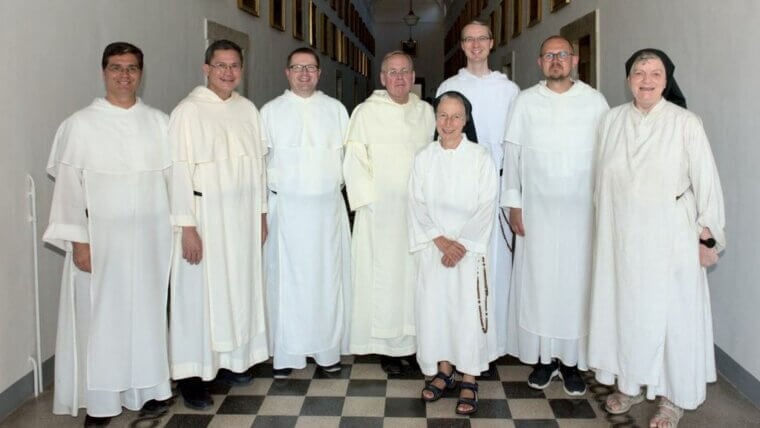
The following homily was preached at the funeral Mass of Brother Jean-Pierre Torrell, OP, on Sept. 6, 2025, in Fribourg. The preacher was Brother Benoît-Dominique de La Soujeole, OP, a Dominican friar and longtime colleague of Br. Jean-Pierre. In his preaching, Br. Benoît-Dominique reflected on the vocation of the theologian as both disciple and master—an identity that Br. Jean-Pierre lived with fidelity throughout his life and teaching.
The readings of the Liturgy of the Word were chosen in light of the one whose funeral we celebrate today, Fr. Jean-Pierre Torrell. For the word funeral (obsèques) comes from the Latin obsequium, which means, “respect, deference.” It is therefore for us a matter of showing deference to the deceased, because, among us, he was an example. In what way, in particular?
He showed us the distinction and the relationship that exist between a disciple and a master, because far from separating the two, he was both. But to understand this, we must return to the supreme example, which is Christ.
The first reading takes up the third Servant Song in the Book of Isaiah: “The Lord has given me the ear and the mouth of a disciple” (Is 50:4). It is one of the clearest prophecies of the mystery of Christ, the disciple par excellence in his relationship with the Father: “Everything I have heard from my Father, I have made known to you.” (Jn 15:15). The quality of being a disciple comes first and is foundational.
Encountering the Master of Masters
The Gospel recounts part of the dialogue between Jesus and Nicodemus. The latter was regarded as a teacher in Israel, and yet Jesus teaches him—above all, the new birth. Jesus, the Master of masters.
It is easy to oppose the disciple to the master: the disciple is the one who receives; the master is the one who gives. In reality, however, and in many ways, the two are very intimately united: what I can transmit as a master, I must first have received. The master is the disciple who transmits, provided he remains faithful to what he first heard. In the mystery of Christ these are profoundly united. The disciple first has an ear to listen and then a mouth to speak (Jn 15); and it is then that he becomes master.
We also find here the foundation of that particular rationality which is theology. First, it requires disciples; this is the auditus fidei. Then it gives rise to masters, the intellectus fidei. The theologian is at once disciple and master, in an order where the disciple is always first and the master always second.
This has an even broader application.
Within the very intellectus fidei we find again this necessity of receiving before transmitting.
We know the distinction between “Thomist” and “Thomasian.” How should we understand it? For some it has meant two ways of considering St. Thomas Aquinas: either as a witness to the theology of his own time, or as an inspirer for today. “Thomasian”—for historians of ideas? “Thomist”—for contemporary theologians? Let us not separate them. Here too, it is necessary first to receive in order to transmit: one is Thomasian in order to be Thomist; one is Thomist because one is Thomasian. It is the initial contact with the writings of St. Thomas that allows them to speak anew today. To put it another way: a close exegesis of Thomistic texts in their historical-doctrinal context, and a critical dialogue with contemporary authors. Thus the beautiful tree of a theological tradition always drives its roots deeper so that it may spread out its branches heavy with fruit.
Disciple in order to be master; master on the condition of being a disciple. This is the great testimony that our brother leaves to his brothers, to all who had the grace of having him as a professor, and to all who can still have the grace of reading his many books. May this outstanding merit open for him the gates of Heaven!