Cum qui recipit prophetam (And whoever receives a prophet), MT 10:41.
“He who receives a prophet.” These words open the two oldest Dominican documents preserved in this convent’s archives. These are bulls of recommendations, dating from the second decade of the 13th century; issued by Pope Honorius III. In a way, they were passports to legitimize new itinerant preachers.
By choosing this quotation from the Gospel of St. Matthew as the title of the bull, Honorius III defined who he considered these new preachers to be. They are prophets.
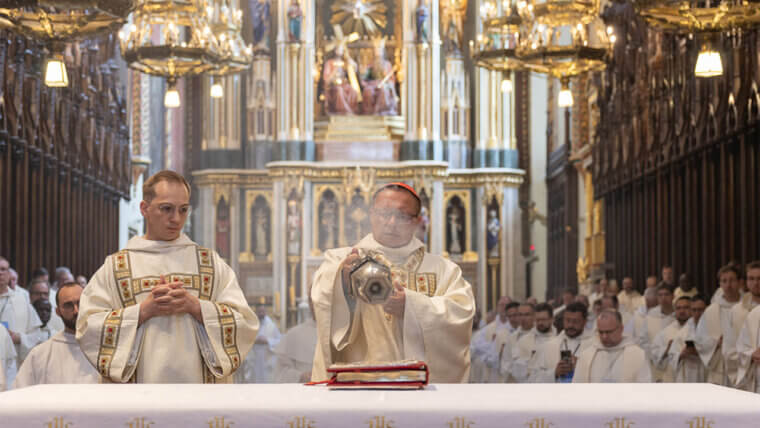
We have come from the four corners of the world. We speak different languages. We carry within us the richness of multiple cultures. We are meeting as a chapter to renew our Dominican and prophetic identity, so that in three weeks’ time, we will once again be sent by the successor of Saint Dominic to our respective countries, with the mission of speaking only one language: that of the Gospel.
- Cum qui recipit prophetam
Today, the Church invites us to meditate on the Book of Exodus. We have just heard that the Israelites are leaving Egypt. After centuries of enslavement and humiliation, they become a free people. We know how much effort it will take them to learn to be free: first in their wanderings through the desert, then in the Promised Land. They will receive prophets, starting with Moses, who will teach them freedom. Then, the people themselves, having become a free people, will become a prophetic people.
A prophet is a free human being. He belongs solely and exclusively to the Word of God. He is a slave to God’s Word. Being a slave to God’s Word is liberating for the prophet. So no human word, no opinion or point of view, no social context, not even the prospect of death, can stop him.
Fear cannot bind him either, nor can personal limitations, even moral weakness.
My favorite quality about St. Dominic is his inner freedom. You can see it in the key decisions he made: when he sent very young friars out into the world, without fear that they would distort his founding idea, or simply leave. It was because of this inner freedom that he also convened the first chapter and entrusted the brothers with the responsibility of deciding the future of the Order.
- Cum qui recipit prophetam
“Whoever receives a prophet”. In today’s Gospel, we see Jesus as a prophet in whom the words of Isaiah are fulfilled. As a prophet, He is a servant of the truth. “He will proclaim the law to the nations,” says Isaiah about Him.
A prophet is a servant of the truth that surpasses him and captivates him.
However, Jesus, when addressing a person, simultaneously becomes a servant of the truth about his fragile and earthly condition: “He will not break a crushed reed, nor will he quench a smoldering wick.”
Through the preacher — the prophet — the encounter between the captivating truth of eternity and the sorrowful truth of earthly life takes place. The prophet is a servant of both. He has the privilege of observing and participating in the healing power of God’s truth, which lifts up and heals the wounded person.
On the occasion of the chapter, we will touch upon a fragment of 20th-century history that took place in this region where we are. When we go to Auschwitz, we will symbolically see the sorrowful truth about the failure of humanity. But we will also see that God did not remain silent in the face of this human failure and brought His response. He called, almost at the same time and in the same place, two prophets: a simple nun named Faustina and a priest named Karol, who conveyed to the humiliated humanity of the 20th century that God is “rich in mercy” (dives in misericordia).
God is not a silent God, for He calls us to be preachers and prophets so that His response to the various crises of the world we live in may be made heard through us.
The preacher as a prophet must not forget that he himself is a wounded person. He is a “man with unclean lips.” It is first in his own life that God’s truth, to which he ministers, heals his personal unrighteousness and enables him for the mission.
The words of Pope Leo addressed to priests (preachers and prophets) are comforting for us: “Do not be daunted by your personal frailty: the Lord does not look for perfect priests (preachers and prophets), but for humble hearts that are open to conversion.”
- Cum qui recipit prophetam
“And whoever receives a prophet.” We gathered at the tomb of St. Hyacinth. He was a restless spirit. On the one hand, St. Dominic sent him to go as a charismatic preacher far to the north and to the far east, going as far as Kiev. On the other hand, he knew that the charismatic mission had to be supported by a structure; that is why during his lifetime he founded several dozen convents.
Gathering together with him in Chapter, we want to renew the prophetic mission in the Order “to the ends of the earth”. We cannot reduce it to the mission of “going as far as we can”. There is a great difference between one and the other. The dynamic of the Order comes from the holy courage to set great tasks and to aspire to the horizon that God draws for us, a horizon that today exceeds our projects and our imagination. It is a perspective that gives space for the action of the Holy Spirit, who wants to send us further than our imagination can reach. It is a perspective that frees us from our pettiness.
Today we try to define the “ends of the earth” to which we are sent today. However, we do not know how they will materialize tomorrow, when we go to those who have never known Christ, to those who have drifted away from Him or remain distant, or to those who love Him deeply but still need a deeper rootedness in Him.
We do not know what those confines will be like tomorrow, but today, as an Order of Preachers, we want to say that we are ready to go there, because we want to be faithful to our prophetic mission.
In addition, St. Hyacinth left behind a Dominican structure because he learned from St. Dominic that structure matters. We usually think of St. Dominic as an itinerant preacher, but in reality he dedicated the last years of his life to administrative work.
- Sapientis est ordinare (it is the mark of a wise person to order)
The task of the wise person is to establish order.
Care for administration, transparency, order, structures and management are a service to our prophetic vocation.
We must remember this as provincials. We must remind ourselves as provincials. Our daily hard work, as well as this chapter meeting, is a prophetic sign.
Holy Spirit, guide us as prophets towards inner freedom!
Holy Spirit, give us prophetic passion to serve the truth!
Holy Spirit, grant us generous availability to assume the mission wherever you send us!
Lectures of the day:
Ex 12, 37-42
Ps 135 (136), 1.23-24, 10-12, 13-15
Mt 12, 14-21
🪶
Preacher: Brother Łukasz Wiśniewski, OP
Krakow, July 19, 2025
Communications Office – General Chapter of Provincial Priors
Łukasz Janik OP
Photo: @dominikanie.pl